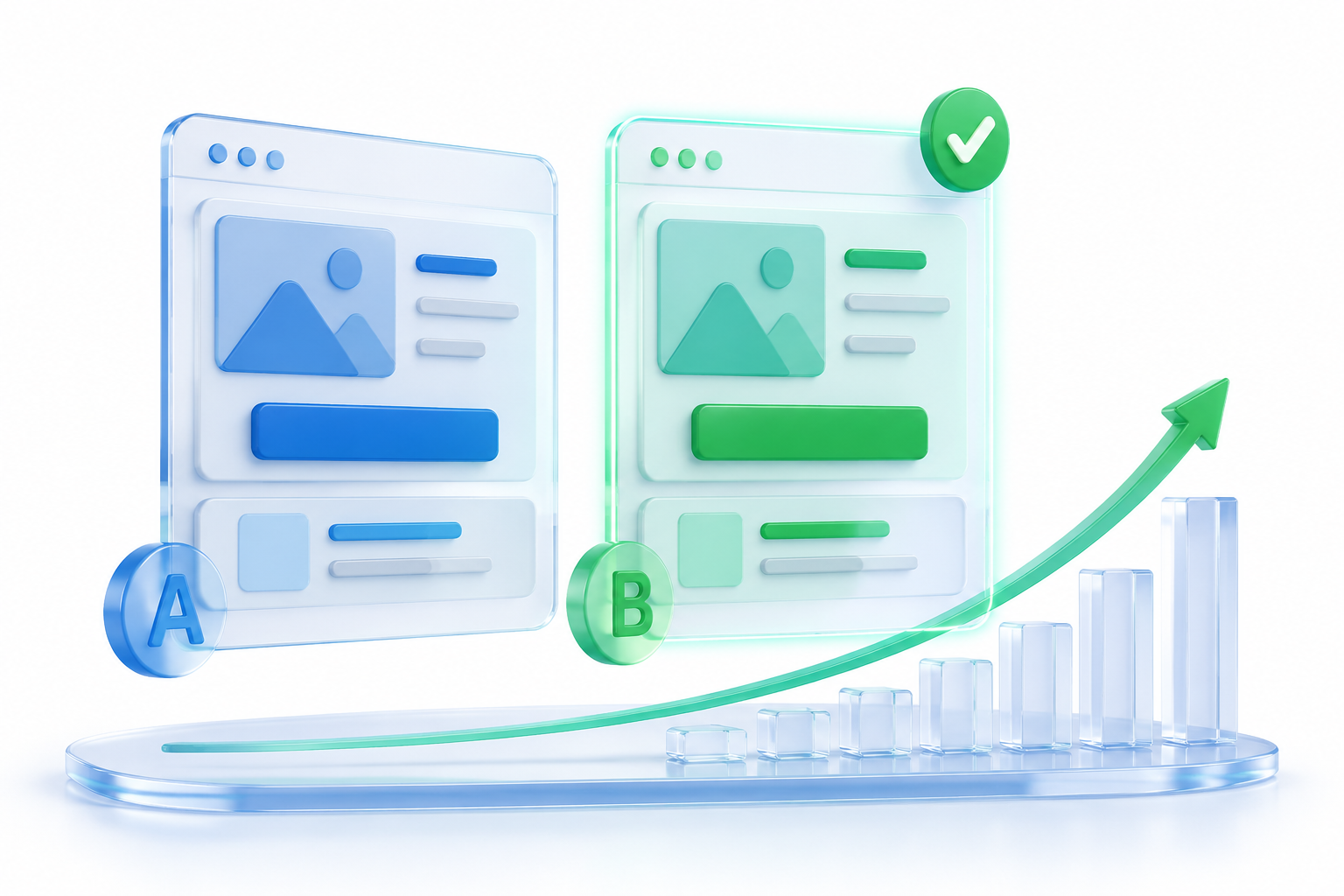
Conversion Rate Optimization that delivers results.
What's included?
•
Strategic Foundation
•
Conversion rate lift studies with data driven approach
•
A/B Testing for Optimal Performance
•
Full Campaign Management and Monitoring
•
UI UX Behaviour Studies
•
Performance Analytics and Reporting

Why choose Conversion for CRO services
We offer complete conversion rate optimization services, from strategy and lift studies backed by data creation on an ongoing optimization. We also conduct GEO specific studies custom tailored to your brand. Customizable plans and flexible options are available to fit your goals and budget.
Conversion Rate Optimisation Services: Turn More Visitors into Customers
Every day, your website receives visitors who leave without converting. They browse your product pages, read your content, hover over your call-to-action buttons — and then disappear. The global average website conversion rate sits at just 3.68%, which means over 96% of your traffic generates zero revenue. For ecommerce businesses, the picture is even starker: average conversion rates hover between 2% and 5%, with cart abandonment rates reaching a staggering 69.99% across industries and spiking to 85.65% on mobile devices.
Conversion rate optimisation (CRO) is the systematic, data-driven process of increasing the percentage of website visitors who take a desired action — whether that is making a purchase, submitting a lead form, signing up for a free trial, or booking a consultation. Unlike acquisition marketing, which focuses on driving more traffic, CRO focuses on extracting more value from the traffic you already have. It is the single most cost-effective growth lever available to digital businesses because it improves the return on every marketing pound you spend — across paid search, organic SEO, social media, email campaigns, and display advertising simultaneously.
At Conversion, we deliver comprehensive CRO services that combine behavioural analytics, user experience research, A/B testing, landing page optimisation, and funnel analysis to systematically improve your website's ability to convert visitors into customers. Our approach is grounded in data, informed by user psychology, and validated through rigorous experimentation. Companies using structured CRO programmes see an average return on investment of 223%, and brands that run 10 or more tests per month grow 2.1 times faster than those that do not.
This page is your complete guide to understanding CRO: what it is, why it matters, how it works, what results you can expect, and how Conversion's optimisation services can transform your digital performance. We have included the latest 2025–2026 benchmarks, industry data, strategic frameworks, real-world case studies, and proven tactics so you can make informed decisions about investing in conversion rate optimisation for your business. Whether you are an ecommerce brand battling cart abandonment, a B2B company struggling with lead quality, or a SaaS business optimising trial-to-paid conversion, the strategies outlined here are backed by real performance data from thousands of businesses.
What Is Conversion Rate Optimisation?
Conversion rate optimisation is the practice of improving the performance of your website, landing pages, and digital funnels to increase the percentage of visitors who complete a desired action. The conversion rate formula is straightforward: divide total conversions by total visitors, then multiply by 100. If your site receives 50,000 visitors per month and 1,500 convert, your conversion rate is 3%.
But CRO is far more than a mathematical exercise. It is a multidisciplinary practice that draws on user experience design, behavioural psychology, data analytics, persuasive copywriting, and statistical testing. Effective CRO requires understanding why visitors behave the way they do — what motivates them, what creates friction, what builds trust, and what triggers action. It requires forming hypotheses based on qualitative and quantitative data, designing experiments to test those hypotheses, and implementing changes only when the data confirms they produce genuine improvements.
CRO builds on five interconnected pillars: A/B testing to identify winning variations, user experience design to retain visitor interest and reduce friction, landing page optimisation to encourage specific actions, persuasive copywriting to drive decisions, and web analytics to pinpoint improvement areas. Together, these components form a comprehensive approach to turning more website visitors into customers, leads, or subscribers without increasing your advertising budget.
Macro vs. Micro Conversions
Not all conversions carry equal business value. Macro conversions are primary business objectives that directly drive revenue: completed purchases, paid subscription sign-ups, qualified lead form submissions, booked demos, or signed contracts. Micro conversions are smaller engagement signals that indicate progress through the buyer journey: email newsletter sign-ups, product page views, add-to-cart actions, content downloads, video views, account registrations, or social shares.
Tracking both types is essential for effective CRO. Micro conversions serve as leading indicators of macro conversion performance and help identify where visitors disengage in your sales funnel. A visitor who adds items to their cart but does not complete checkout signals a different optimisation opportunity than a visitor who bounces from the homepage without viewing any products. Understanding this distinction helps prioritise your testing roadmap and allocate resources where they will generate the highest return.
The CRO Market Opportunity
The conversion rate optimisation software market was valued at $3.01 billion in 2019 and is projected to reach $5.07 billion by 2026, with some estimates suggesting it will hit $5 billion as early as 2025. This growth reflects increasing recognition among businesses that acquiring traffic is only half the equation — converting that traffic is what determines return on investment. Despite this market expansion, 68% of small businesses still operate without any defined CRO strategy, and only 39.6% of companies have a fully documented CRO plan. Even more revealing, for every $92 spent on acquiring new leads, only $1 is allocated to converting or retaining them. This gap represents an enormous competitive advantage for businesses that invest in systematic optimisation.
The adoption of CRO tools and techniques continues to accelerate. Currently, 69% of marketers use web analytics tools in their CRO stack, 64% employ user experience testing, 61% use personalisation tools, and 57% integrate content testing into their optimisation workflows. AI personalisation has emerged as the leading CRO technique, used by 28.2% of marketers, followed by A/B testing at 24.1%, chatbots at 18.7%, interactive content at 16.6%, and multivariate testing at 12.4%.
3.68%Global Average Website Conversion Rate
223%Average ROI from CRO Tools
$5.07BCRO Software Market by 2026
69.99%Average Cart Abandonment Rate
2.1xFaster Growth with 10+ Monthly Tests
68%Small Businesses Without CRO Strategy
Conversion Rate Benchmarks by Industry (2025–2026)
Understanding where your conversion rate stands relative to industry benchmarks is essential for setting realistic goals and identifying improvement opportunities. Conversion rates vary dramatically by sector, business model, traffic source, and device type. Here are the latest benchmarks based on aggregated data from 2024–2025, covering website performance, paid advertising, landing pages, and vertical-specific standards.
Website Conversion Rate Benchmarks
The average conversion rate across all industries is approximately 2.9%. The global average website conversion rate is 3.68%. The top 25% of websites achieve conversion rates of 5.31% or higher, while the top 10% reach 11.45% or more. For ecommerce specifically, the average sits at 2.27–2.7%, with a conversion rate above 3.2% placing you in the top 20% of online stores. If your ecommerce conversion rate exceeds 4.8%, you are performing among the elite. Conversely, rates below 0.2% signal an urgent need for optimisation. The median conversion rate across all industries in benchmark reports reaches 6.6%, though this figure includes both micro and macro conversions.
EcommerceAverage: 2.27–2.7%. Top 20%: above 3.2%. Elite: above 4.8%. Seasonal spikes in Q4 (holiday season). Cart abandonment averages 69.99%. Food and beverage leads at 3.7% in Q4. Luxury goods average just 0.3%. Mobile ecommerce conversion rate averages only 1.6%.
B2B EcommerceAverage: 1.8%. Finance sector: 3.1%. SaaS visitor-to-lead: 1.4% (SMBs), 0.7% (enterprise). MQL-to-SQL conversion: ~40% across both segments. Email traffic converts 5–6x better than paid for ecommerce landing pages.
Google AdsAverage: 7.04% across 17,000+ campaigns (10% YoY decline). Physicians/Surgeons: 13%+. Jewellery/Apparel: lowest performing vertical. Top 10% of advertisers achieve 11.45%. Paid search median: 3.2%.
Landing PagesAverage: 2.35–4.4%. High-intent pages: 9–12%. Top 10%: 11.45%+. Long-form pages generate 220% more leads than short-form. Later achieved 60% average conversion rate on gated content landing pages.
Insurance & FinanceMedia conversion rate: 18%+. Financial sector overall: 8%+. Paid search median: 10.1%. Paid social: 9.3%. Google Ads converts 54%+ of visitors. Real estate referred leads: 55% booked site visits.
Email MarketingAverage CTR: 8.93% across industries. CRO-optimised email landing pages convert 20% higher than generic URLs. Abandoned cart emails: 41.8% open rate, 10.7% conversion rate. CRO-optimised emails generate 31% higher click-through rates.
SaaS & SoftwareAverage trial conversion rate: 5.2%. Top SaaS companies: 12–18% trial conversion. Adding a free trial button increases conversions by 14%. Product tours increase sign-ups by 16%. Clear pricing pages convert 11% higher.
Sporting Goods & RetailSporting goods: lowest ecommerce conversion at 2.35%. 60–70% of A/B tests in gaming and sports find winning variations. Content marketing generates 3x more conversions. Branded video drives 64% purchase rate after viewing.
Mobile vs. Desktop Conversion Rates
The device gap remains one of the most significant CRO opportunities available. Desktop consistently converts at approximately 3.2–4.8%, while mobile trails at roughly 1.6–2.9% — despite mobile accounting for 68% of all ecommerce sales globally. On mobile, cart abandonment spikes to 85.65%, compared to approximately 69.99% across all devices. Landing pages optimised for mobile convert 26% higher than non-optimised pages, and mobile-optimised checkout flows increase conversions by 22%. Mobile-friendly sites convert 30–45% higher than non-optimised ones overall.
This gap exists because mobile users face smaller screens, more difficult form inputs, slower connections, and more distractions. Yet 85% of consumers believe a company's mobile website should be as good as, if not better than, its desktop version, and 57% of online users state they would not recommend a business with a poorly designed mobile website. Mobile users are approximately 5 times more likely to abandon a site that is not mobile-friendly. The brands that close this mobile conversion gap stand to capture an enormous revenue opportunity — stores with Apple Pay and Google Pay see 21% higher mobile conversions, and sticky CTAs improve mobile conversions by 12%.
Conversion Rate Benchmarks by Traffic Source
Not all traffic converts equally. Email traffic converts 5–6 times better than paid traffic for ecommerce landing pages. Paid search usually achieves a conversion rate of approximately 3.2%, while paid social contributes about 2.1% on average. Organic search traffic typically converts between 2–3% for ecommerce but can reach 5–8% for high-intent informational queries leading to lead capture. Referral traffic performs variably depending on the referring source, but tends to carry higher intent than broad social media traffic. Direct traffic — visitors who type your URL directly — often converts highest of all, reflecting brand recognition and existing trust. Understanding conversion rates by traffic source helps allocate budget toward channels that deliver not just volume but quality.
The Business Impact of CRO: Why Optimisation Drives Revenue
Conversion rate optimisation is not just about incremental improvements to website metrics. It is a revenue multiplier that compounds across your entire marketing ecosystem. Here is why CRO deserves a central place in your growth strategy, supported by the latest data on returns, cost savings, and competitive advantages.
Revenue Multiplication Without Extra Traffic
Consider a business generating $500,000 per month from 100,000 visitors at a 2% conversion rate. Increasing that conversion rate to 3% — a one percentage point lift — generates an additional $250,000 per month without spending a single extra pound on advertising. That is $3 million in additional annual revenue from the same traffic. A mid-sized online retailer that increases conversion from 2.5% to 3.0% gains 20% more sales without needing extra visitors. In B2B SaaS, refining the free trial signup flow by even a few tenths of a percent can multiply pipeline value significantly. This revenue multiplication applies across every traffic source simultaneously — your SEO traffic, your PPC campaigns, your email marketing, your social media referrals all become more productive.
Lower Customer Acquisition Costs
Every improvement in conversion rate directly reduces your effective cost per acquisition (CPA). If your CPA through paid search is $50 at a 2% conversion rate, increasing to 4% halves your CPA to $25. This means your existing marketing budget generates twice as many customers, or you can maintain the same customer volume at half the cost — freeing budget for expansion into new channels. When Nature Air made their call-to-action button more prominent and compelling, they saw a 591% increase in conversions without spending an extra dollar on advertising. The compounding effect is powerful: CRO improvements multiply across every channel, meaning a 1% conversion rate improvement effectively increases the value of every marketing pound across your entire acquisition strategy.
The ROI of CRO Investment
Companies using CRO tools report an average return on investment of 223%. In a survey of 173 marketers, some reported generating returns exceeding 1,000% after implementing CRO tools and processes. Brands doing structured CRO programmes see this ROI through multiple channels: higher conversion rates, improved customer lifetime value, lower bounce rates, and better user experience that drives organic referrals and repeat purchases. Companies using A/B testing grow revenue 1.5 to 2 times faster than non-testers, and statistically significant tests can boost conversion rates by up to 49%.
Every $1 invested in user experience design returns $100, representing an ROI of 9,900%. This staggering figure reflects the compounding benefits of better UX: lower acquisition costs, reduced support costs, increased retention, and expanded market share. A well-designed user interface alone can increase conversion rates by up to 200%, and an improved overall user experience can boost conversions by up to 400%. Increasing UX budget by just 10% is correlated with an 83% uplift in conversion metrics in some studies. UX-centric companies tend to grow twice as fast as industry averages.
The Compounding Effect of CRO
Unlike one-time marketing campaigns, CRO improvements are permanent. Once you discover that a certain headline converts 25% better, that improvement continues generating returns indefinitely. Each winning test does not just improve your conversion rate — it teaches your team something valuable about your customers. This organisational learning accumulates over time, making your entire marketing operation more effective. The compound effect means that a business running monthly CRO experiments will have implemented dozens of validated improvements after a year, each one stacking on top of previous gains. This is why companies with structured, long-term CRO programmes consistently outperform those with ad-hoc approaches.
$100Return per $1 Invested in UX Design
200%Conversion Lift from Better UI Design
400%Conversion Lift from Improved UX
$18BAnnual Revenue Lost to Cart Abandonment
49%Max Conversion Lift from Significant A/B Tests
1,000%+Top ROI Reported by CRO Practitioners
Our CRO Process: A Data-Driven Framework
Effective conversion rate optimisation follows a systematic, repeatable methodology. At Conversion, we use a six-phase CRO framework that ensures every optimisation decision is grounded in data, validated through experimentation, and aligned with your business objectives. This research-test-implement-learn cycle creates compounding improvements that accelerate over time.
Phase 1: CRO Audit and Diagnostic Analysis
Every engagement begins with a comprehensive audit of your current digital performance. We analyse your website analytics (Google Analytics 4, heatmaps, session recordings), identify high-impact pages and funnel drop-off points, assess page load speed and Core Web Vitals performance, review your information architecture and user flows, and benchmark your conversion rates against industry standards. We examine your bounce rate by page and traffic source, time-on-site metrics, pages-per-session data, exit page analysis, and scroll depth patterns to understand how visitors interact with your site at every touchpoint.
This diagnostic phase produces a prioritised list of optimisation opportunities ranked by potential revenue impact, implementation complexity, and statistical confidence. We identify quick wins that can be implemented immediately alongside longer-term strategic initiatives that require testing. The audit also evaluates your current analytics infrastructure to ensure you have accurate data collection in place — without reliable data, optimisation decisions are built on sand.
Phase 2: Qualitative and Quantitative Research
Data tells you what is happening on your site. Research tells you why. We combine quantitative analytics (funnel analysis, cohort analysis, traffic segmentation, device and browser breakdowns, geographic performance variations) with qualitative research methods (user surveys, on-site polls, customer interviews, usability testing, session replay analysis, and heuristic evaluations). This dual approach reveals the specific friction points, confusion, objections, and trust deficits that prevent visitors from converting.
We use tools including heatmap analysis to understand visual attention patterns, scroll maps to identify content engagement depth, click maps to detect rage clicks and dead clicks, form analytics to find field-level abandonment, and customer journey mapping to visualise the complete path from first touch to conversion. We also conduct competitive analysis to understand how your competitors handle similar conversion touchpoints, what trust signals they display, and where your user experience falls short of market expectations. These insights form the foundation of our experimentation roadmap and ensure that every hypothesis is grounded in real user behaviour rather than assumption.
Phase 3: Hypothesis Development and Prioritisation
Based on our research findings, we develop specific, measurable hypotheses for improving conversion rates. Each hypothesis follows a structured format: "If we change [element], then [metric] will improve by [amount], because [reasoning based on research data]." Hypotheses are prioritised using the ICE framework (Impact, Confidence, Ease) or PIE framework (Potential, Importance, Ease) that weighs potential revenue impact, confidence level based on supporting evidence strength, and ease of implementation.
This disciplined approach prevents the common trap of making changes based on opinion, best practices articles, or competitor imitation. Every experiment has a clear rationale, a defined primary success metric and secondary metrics, a minimum sample size calculated in advance to ensure statistical significance, and a predetermined run time. A/B tests require approximately 25,000 visitors to achieve statistical significance, which informs our testing cadence and traffic allocation decisions. We typically maintain a backlog of 20–50 prioritised hypotheses at any given time, ensuring we always have the next experiment ready to launch.
Phase 4: A/B Testing and Experimentation
A/B testing is the backbone of evidence-based CRO. We design controlled experiments that isolate specific variables — headlines, CTAs, layouts, pricing displays, form fields, trust signals, imagery, copy, colour schemes, navigation patterns, and content hierarchy — and measure their impact on conversion rates with statistical rigour. A/B testing alone lifts conversions by an average of 18% after 6 months of consistent testing, and 77% of companies run A/B testing on their websites. 75% of the top 500 online retailers use A/B testing platforms.
Our testing programme goes beyond simple A/B tests. We run multivariate tests to evaluate multiple variables simultaneously, split URL tests for radically different page designs, server-side tests for personalisation and dynamic pricing experiments, and sequential tests for incremental improvements over time. Simple A/B changes to headlines, buttons, and form design can yield gains in the 10–30% range. Companies that run 10 or more tests per month grow 2.1 times faster than those running fewer tests — velocity matters because each test generates learning that informs the next experiment.
Phase 5: Implementation and Quality Assurance
When an experiment produces a statistically significant winner, we move to implementation. This includes full front-end development of the winning variation, cross-browser and cross-device testing across Chrome, Safari, Firefox, Edge, iOS, and Android, performance validation to ensure changes do not negatively impact page speed or Core Web Vitals scores, accessibility compliance checks against WCAG 2.1 AA standards, and integration testing with your analytics and marketing technology stack. We do not simply "ship the winner" — we validate that the improvement holds under real-world conditions across all device types and screen sizes before full deployment.
The cost to implement winning variations — including hardcoding, design, and development — is often overlooked but significant in CRO budgets. We factor implementation costs into our prioritisation framework to ensure that the expected revenue gain from each experiment justifies the development investment required to make it permanent.
Phase 6: Continuous Optimisation and Reporting
CRO is not a one-time project — it is a continuous improvement process. Each test generates insights that inform the next round of hypotheses, creating a compounding cycle of optimisation. Longer-term CRO programmes (6+ months) consistently outperform short bursts due to accumulated learning and compounding effects. Our reporting includes detailed experiment documentation with full statistical analysis, revenue impact calculations tied to specific test results, confidence intervals and significance levels, segment-level analysis by device, traffic source, and user type, and strategic recommendations for the next testing cycle.
We document every hypothesis, test result, and learning in a shared knowledge base. By documenting CRO learnings, teams can track strategy development, learn from past outcomes, and avoid repeating ineffective approaches. This practice fosters transparent communication, knowledge sharing among team members, and efficient progress tracking across your entire organisation.
Our Conversion Rate Optimisation Services
At Conversion, we offer a full suite of CRO services designed to systematically improve every stage of your customer journey. Each service can be engaged individually or as part of a comprehensive optimisation programme tailored to your business objectives, traffic volume, and growth targets.
Website CRO Audit
Our CRO audit is a deep-dive diagnostic that identifies the specific barriers preventing your website from converting at its full potential. We analyse your analytics data, user behaviour patterns, technical performance, content effectiveness, and competitive positioning to produce a prioritised roadmap of optimisation opportunities. The audit covers every critical conversion touchpoint: homepage, category pages, product pages, pricing pages, checkout flow, lead capture forms, account creation process, and post-conversion experience. We evaluate your site against 100+ conversion best practices across usability, persuasion, trust, clarity, and motivation. The deliverable is a detailed report with specific, actionable recommendations ranked by estimated revenue impact.
A/B Testing and Experimentation Programme
We design, execute, and analyse a continuous programme of controlled experiments targeting your highest-impact conversion opportunities. This includes hypothesis development, test design, statistical planning (including minimum detectable effect and required sample size calculations), implementation, monitoring, and results analysis. Our testing programme covers headlines and value propositions, call-to-action design and placement, page layout and information hierarchy, form design and field optimisation, pricing presentation and social proof placement, checkout flow and payment options, trust signals including security badges and testimonials, navigation patterns and menu structure, image selection and product photography, and content length and format.
Landing Page Optimisation
Landing pages are often the first and sometimes only opportunity to convert a visitor. The average landing page conversion rate is 2.35–4.4%, but well-optimised pages achieve 9–12% or higher. Later achieved a 60% average conversion rate on their gated content landing pages, generating over 100,000 new leads. Taylor Made Marketing regularly achieves 35% conversion rates in the home improvement sector compared to the industry average of 3–5%. We optimise every element of your landing pages: headline clarity and emotional resonance, above-the-fold value proposition, visual hierarchy and eye-tracking alignment, CTA prominence and persuasive copy, social proof and trust signal placement, form design and progressive profiling, page speed and mobile responsiveness, and content length and format (long-form pages generate 220% more leads). Removing navigation links from landing pages increases conversions by 15%.
User Experience Research and Design
UX research underpins everything we do. We conduct usability testing with real users, card sorting exercises, tree testing for information architecture, first-click testing, preference testing, five-second testing, and accessibility audits. These qualitative insights reveal friction points that quantitative data alone cannot identify — the moments of confusion, hesitation, and frustration that cause visitors to abandon their journey. 88% of users will not return to a site after a poor user experience, making UX the foundational layer of conversion performance. UX improvements alone can raise conversions by 30%, and enhancing on-site search increases purchases by 19%.
Ecommerce Conversion Optimisation
Ecommerce CRO requires specialised expertise across the entire shopping experience: product discovery and search functionality (enhancing on-site search increases purchases by 19%), product page design and information architecture, pricing and promotion strategy, cart and checkout optimisation (simplifying checkout to one page improves conversions by 17%), payment options and trust signals (offering PayPal or digital wallets increases conversions by 14%), post-purchase experience and upselling, and abandoned cart recovery strategies (abandoned cart emails achieve 41.8% open rates and convert approximately 10–14% of recipients). Showing total cost earlier reduces abandonment by 19%. Adding guest checkout boosts conversions by 18%. Trust signals at checkout increase conversions by 9%. Autofill-enabled fields boost form completion by 12%.
Mobile Conversion Optimisation
With mobile traffic accounting for 68% of all ecommerce sales but converting at significantly lower rates than desktop, mobile CRO represents one of the largest untapped revenue opportunities for most businesses. We optimise mobile experiences for touch interaction patterns, simplified navigation, streamlined checkout flows, accelerated page loads (53% of users leave a page that takes longer than 3 seconds to load), and responsive form design. Mobile-optimised landing pages convert 26% higher than non-optimised pages. Mobile-first page designs outperform desktop-first by 17%. Sticky CTAs improve mobile conversions by 12%. Stores with Apple Pay and Google Pay see 21% higher mobile conversions. Mobile-optimised checkout flows increase conversions by 22%.
Personalisation and Dynamic Content
Personalisation is one of the most powerful CRO levers available and the leading technique used by 28.2% of marketers. Personalised CTAs convert 42% more visitors than generic ones, and personalised landing pages outperform generic pages by 22%. AI-powered CRO platforms are now delivering average conversion lifts of approximately 25% for adopters. Unbounce Smart Traffic increases conversions by up to 30% by matching users with the most relevant content automatically. Amazon sellers using AI tools for product listing optimisation have seen conversion rates jump from 26% to 46% over eight weeks. We implement personalisation strategies based on traffic source, user behaviour, geographic location, device type, customer segment, purchase history, and stage in the buyer journey.
Analytics and Conversion Tracking Setup
Accurate measurement is the foundation of effective CRO. We implement and configure Google Analytics 4, Google Tag Manager, conversion tracking pixels, enhanced ecommerce tracking, custom event tracking for micro-conversions, cross-domain tracking, server-side tracking, and attribution modelling. Without proper analytics infrastructure, optimisation decisions are based on assumption rather than evidence. We also implement event-based tracking for scroll depth, video engagement, file downloads, outbound link clicks, and form interactions — the micro-conversion data that reveals where visitors engage and where they disengage.
Conversion Copywriting
Words drive decisions. Our conversion copywriting service optimises the language across your entire digital experience — from headlines and value propositions to product descriptions, CTA button text, error messages, and microcopy. Going doubled their premium trial starts with a simple CTA button text change, achieving a 104% month-over-month increase. Shifting CTA copy from second person to first person boosts conversions by 90%. Action-oriented copy drives dramatically different results: L'Axelle achieved 93% more clicks by switching to action-oriented language. We write copy that reduces friction, builds trust, addresses objections, and creates clarity at every decision point in the customer journey.
CRO Tactics That Move the Needle: Data-Backed Strategies
Based on the latest research and aggregated performance data from thousands of experiments, here are the specific CRO tactics that consistently produce measurable conversion improvements across industries and business models.
Call-to-Action Optimisation
Your CTA is the most critical conversion element on any page. Personalised CTAs improve conversion rates by 202%. CTAs designed as buttons experience a 45% increase in clicks compared to text links. Embedding anchor text CTAs directly within content generates 121% more conversions than isolated buttons or banners. CTAs surrounded by white space increase conversions by an astounding 232%. Shifting CTA copy from second person ("you") to first person ("me") has been shown to boost conversions by 90%. Landing pages with a single CTA convert 32% better than those with two or more CTAs. Button colour tests yield an average 6% lift when improved. TrustRadius doubled their click-through rates by switching from banner CTAs to sticky buttons in a static header. Video platform Willo increased conversions by over 50% when they redesigned their homepage to focus on just one CTA.
Page Speed and Technical Performance
Site speed directly impacts conversion rates and is the single most overlooked CRO factor. A one-second improvement in page load time can boost conversions by 4–7%, and keeping load times under two seconds increases conversions by up to 15%. Every additional second of load time reduces conversions by approximately 7%. On mobile, the impact is even more dramatic — 53% of users leave a page that takes longer than 3 seconds to load. Firefox saw a 15.4% download increase from faster page speed alone. Google's Core Web Vitals (Largest Contentful Paint, Interaction to Next Paint, Cumulative Layout Shift) have become both ranking factors and conversion factors. 39% of users stop engaging with content when loading takes too long. Performance optimisation includes image compression and next-gen formats (WebP, AVIF), CDN implementation, JavaScript minification and defer strategies, critical CSS extraction, server response time reduction, and browser caching configuration.
Form Optimisation and Lead Capture
Form fields are conversion killers when poorly designed. Reducing form fields from 7 to 3 increases conversions by 20–35%. When FSAstore.com streamlined its lead funnel by reducing form fields, it achieved a 53.8% increase in average sales revenue per visitor. Shortening sign-up forms boosts B2B conversions by 27%. Expedia famously increased annual profit by $12 million by removing just one form field. Multi-step forms often outperform single-page forms for complex data collection, as they reduce perceived effort. Progressive profiling — collecting information gradually across multiple interactions — maintains conversion rates while building more complete customer profiles over time. Autofill-enabled fields boost form completion by 12%.
Trust Signals and Social Proof
Trust is the foundation of online conversion. Adding trust badges increases conversions by 7–12%. Including customer testimonials boosts landing page conversions by 14%. User-generated content in SaaS can increase conversions by 154%. Case studies increase B2B landing page conversions by 22%. Users trust images of real people 20% more than stock photos. Ratings, reviews, case studies, security certifications, money-back guarantees, and client logos all serve as trust signals that reduce purchase anxiety and accelerate decision-making. Trust signals at checkout specifically increase conversions by 9%. Highrise achieved a 102.5% signup increase by adding human photos to their landing page.
Live Chat, Chatbots, and Conversational CRO
Chatbots and live chat are proven conversion accelerators. Chatbots improve conversion rates by 27%. Offering live chat increases demo requests by 20%. Real-time interaction reduces friction, answers objections immediately, and guides visitors toward conversion at the moment of highest intent. IBM Bank implemented an exit pop-up on its personal loan application form and improved conversions by 87%. AI chatbots can reduce customer support costs by 30% while being equally accepted as human agents by 40% of consumers, according to Deloitte research. The Weather Channel achieved a 225% conversion boost by decluttering their homepage — sometimes the most powerful conversational CRO tactic is removing obstacles rather than adding features.
Video Content and Rich Media
Pages with video content convert 34% higher on average than pages without video. An astounding 80% of conversions improve when videos are added to landing pages. Branded videos drive 64% of consumers to purchase a product after watching one. When Crazy Egg added video to their homepage, they saw a 64% boost on top of their existing strong performance. Product demonstration videos, customer testimonial videos, explainer videos, and behind-the-scenes content all contribute to higher engagement, longer time on page, and increased conversion rates. Video is particularly effective for complex or high-consideration products where visual demonstration reduces uncertainty and builds confidence in the purchase decision.
Exit-Intent and Cart Recovery Strategies
Exit-intent pop-ups can recover between 7–15% of otherwise lost visitors when deployed with relevant offers or incentives. Exit popups during checkout recover 7–10% of abandoned carts specifically. Broomberg captured 72% more blog leads by adding strategically timed pop-ups after 100 seconds on page. Abandoned cart emails achieve open rates of 41.8% and convert approximately 10–14% of lost sales. Multi-channel recovery combining email and retargeting ads can reclaim approximately 27.62% of abandoned carts. Email nurturing after sign-up increases conversions by 19%. Retailers lose an estimated $18 billion annually to cart abandonment — recovery strategies represent direct revenue recapture. The most effective recovery programmes combine exit-intent pop-ups, abandoned cart email sequences, browse abandonment flows, and retargeting display ads into a coordinated recovery system.
Content Marketing and SEO-CRO Alignment
Companies that leverage content marketing see three times more conversions than those that do not. Blog conversion rates average over 5%, with optimal time spent on posts between 2 and 5 minutes. Marketers who focus on a lead's position in the sales funnel see a 73% higher conversion rate, demonstrating the power of matching content to buyer journey stage. CRO-optimised email landing pages convert 20% higher than generic URLs. Questions in titles evoke curiosity among readers and drive higher click-through and engagement rates. The alignment between SEO and CRO is critical: SEO drives the traffic, CRO converts it, and together they create a compounding growth engine where improvements in either discipline amplify the other.
CRO for Different Business Types
Conversion rate optimisation strategies vary significantly based on business model, industry vertical, average order value, sales cycle length, and conversion objectives. Here is how we approach CRO for the most common business types we serve, with specific tactics and benchmarks for each.
Ecommerce and DTC Brands
Ecommerce CRO focuses on the complete shopping journey from product discovery through checkout completion and post-purchase retention. Key optimisation areas include site search functionality and product filtering (enhancing on-site search increases purchases by 19%), product page information architecture (descriptions, imagery, reviews, sizing, availability), pricing display and promotion strategies, cart page design and cross-selling (Bear Mattress achieved a 24.18% increase in purchases and 16.21% revenue boost from a redesigned cross-sell layout), checkout flow simplification (simplifying to one page improves conversions by 17%), payment method diversity (Apple Pay and Google Pay increase mobile conversions by 21%), and post-purchase experience including order confirmation and shipping notifications.
The primary goal is reducing the 69.99% cart abandonment rate while increasing average order value through strategic upselling and cross-selling. 48% of shoppers abandon carts due to unexpected costs, so showing total costs earlier reduces abandonment by 19%. Adding guest checkout options boosts conversions by 18%. Goldelucks used AI-powered product page optimisation and achieved a 31.56% increase in orders. For ecommerce brands, we also optimise product recommendation algorithms, search result relevance, category page layouts, and promotional landing page performance.
B2B and Lead Generation
B2B CRO differs fundamentally from ecommerce because the conversion event is a lead submission rather than a purchase. This means optimising for lead quality as well as quantity, since a high-volume, low-quality lead pipeline wastes sales resources. Key focus areas include lead form design and progressive profiling, gated content strategy (whitepapers, webinars, reports, calculators), pricing page transparency and plan comparison, demo booking flows, free trial sign-up optimisation, chatbot and live chat implementation (offering live chat increases demo requests by 20%), and lead scoring integration with CRM systems like Salesforce or HubSpot.
In B2B ecommerce, the most effective conversion strategy is proactive notification — 67% of B2B professionals cite back-in-stock alerts as the top conversion driver. Case studies increase B2B landing page conversions by 22%. ArchiveSocial achieved a 101.68% increase in click-through rate through systematic step-by-step CRO testing across their homepage and demo request page. For B2B businesses, we focus on reducing form friction while maintaining lead data quality, building trust through social proof and case studies, and creating clear pathways from awareness content to conversion-ready assets.
SaaS and Software
SaaS CRO concentrates on the critical visitor-to-trial and trial-to-paid conversion points. The average SaaS trial conversion rate is 5.2%, while top SaaS companies convert trials at 12–18%. Average SaaS visitor-to-lead conversion rates are 1.4% for SMBs and just 0.7% for enterprise, making every percentage point improvement highly valuable. Adding a free trial button increases conversions by 14%. Product tours increase SaaS sign-ups by 16%. SaaS companies with clear pricing pages convert 11% higher.
Optimisation targets include homepage value proposition clarity, feature page design and comparison, pricing page architecture and plan selection UX, free trial or freemium sign-up flow, onboarding experience and activation metrics, upgrade prompts and paywall design, and churn reduction through in-app experience optimisation. Hubstaff redesigned their homepage with a revamped navigation, stronger messaging, client logos, and a different hero image, resulting in a 34% increase in hero form submissions. Email nurturing after sign-up increases conversions by 19%. Removing friction from onboarding boosts activation by 12%.
Local and Service-Based Businesses
Local businesses optimise for phone calls, appointment bookings, quote requests, direction lookups, and in-store visits. New Balance Chicago drove 200% more in-store sales by creating mobile-optimised landing pages that connected digital ads to physical store visits. CRO for local businesses focuses on Google Business Profile optimisation, location page design and local trust signals (reviews, local awards, community involvement), click-to-call and click-to-book prominence, review display and management, service page content and pricing transparency, and mobile experience optimisation (local searches are overwhelmingly mobile). For service-based businesses, we also optimise appointment scheduling tools, callback request forms, and the display of availability and response time expectations.
Healthcare and Professional Services
Healthcare CRO requires sensitivity to patient trust, regulatory compliance, and the high-consideration nature of medical decisions. Physicians and surgeons convert over 13% of Google Ads visitors — among the highest of any industry — reflecting the high intent of medical searches. Optimisation focuses on practitioner credentials and trust signals, patient testimonial display (video testimonials are particularly effective), appointment booking flow simplification, insurance information clarity, HIPAA-compliant form design, and mobile optimisation for urgent care searches. Real estate brokerages report that 55% of referred leads book site visits, emphasising the importance of optimising for referral traffic and implementing clear callback promises with specific response time microcopy.
The Psychology Behind Conversion: Why People Buy (or Don't)
Effective CRO is as much about understanding human psychology as it is about analysing data. The most impactful conversion improvements often come from addressing psychological barriers rather than technical issues. Behavioural science provides a framework for understanding the mental models, biases, and emotional triggers that drive decision-making on your website.
The Six Principles of Persuasion
Robert Cialdini's principles of persuasion remain foundational to conversion optimisation. Reciprocity (give value before asking for action — free tools, content, trials), Commitment and Consistency (start with small asks that build toward larger conversions — micro-commitments like quiz completion or email signup before purchase), Social Proof (show that others have converted — reviews, testimonials, customer counts, "popular" labels), Authority (demonstrate expertise and credentials — certifications, media mentions, case studies, expert endorsements), Liking (build rapport and relatability — team photos, brand personality, shared values), and Scarcity (create urgency through limited availability — stock levels, time-limited offers, exclusive access). Each principle can be systematically applied to website design, copy, and user flow.
Cognitive Load and Decision Fatigue
Every element on a page demands cognitive processing. When visitors face too many choices, too much information, or too complex a decision, they experience cognitive overload and default to the easiest option: leaving. This is why pages with fewer than 10 elements convert at double the rate of pages with 40+ elements, and why landing pages with a single CTA convert 32% better than those with multiple CTAs. Yuppiechef removed the navigation from a landing page and saw sign-up conversion rates double from 3% to 6%. Reducing cognitive load — through clear visual hierarchy, progressive disclosure, intentional simplicity, and removal of unnecessary choices — is one of the most reliable CRO strategies available.
Hick's Law states that decision time increases logarithmically with the number of options presented. Applied to CRO, this means simplifying pricing tiers (three options is typically optimal), reducing product variants displayed per page, limiting navigation menu items, and using visual hierarchy to guide attention toward a single primary action. Every element you add to a page should earn its place by either building trust, reducing objections, or advancing the visitor toward conversion. Everything else is noise.
Loss Aversion, Urgency, and Scarcity
Humans feel losses approximately twice as strongly as equivalent gains — a principle known as loss aversion. This psychological asymmetry underlies effective urgency and scarcity tactics: countdown timers, limited stock indicators, expiring offers, "last chance" messaging, and "items left in stock" notifications. However, artificial urgency that feels manipulative erodes trust. The most effective approach uses genuine scarcity signals backed by authentic inventory or deadline constraints. Rewriting microcopy — labels, error messages, and helper text — to emphasise what visitors will miss by not converting leads to measurable lifts; even small copy changes can produce 8% conversion improvements.
The Trust Equation
Online conversion requires overcoming the inherent trust deficit of digital transactions. Trust is built through credibility (expertise signals, certifications, media mentions — authority principle), reliability (consistent experience, uptime, delivery promises kept), intimacy (personalisation, empathy, understanding of needs — liking principle), and low self-orientation (putting customer interests first — transparent pricing, easy returns, no hidden fees). Each trust element can be optimised through specific design and content strategies. Adding trust badges alone increases conversions by 7–12%. 84% of mobile users cite data privacy and security as top concerns when interacting with digital businesses. Users trust images of real people 20% more than stock photos.
The BJ Fogg Behaviour Model
Stanford researcher BJ Fogg's Behaviour Model states that behaviour occurs when three elements converge at the same moment: motivation (the visitor wants the outcome), ability (the action is easy enough to complete), and a trigger (a prompt to act now). CRO applies this model by increasing motivation through compelling value propositions and social proof, increasing ability by reducing friction and simplifying processes, and optimising triggers through strategic CTA placement and timing. When a visitor has high motivation but low ability (e.g., a complex checkout), simplification produces dramatic results. When ability is high but motivation is low (e.g., a simple form for an uncompelling offer), improving the value proposition is the priority.
15 Proven CRO Strategies for 2025–2026
Drawing from the latest research, platform data, real-world case studies, and aggregated performance benchmarks from thousands of experiments, here are 15 strategies that consistently drive conversion improvements across industries.
01Optimise Page Load Speed Below 2 Seconds
Every second of delay reduces conversions by 4–7% (up to 20% on mobile). Pages loading under 2 seconds see up to 15% higher conversions. 53% of mobile users leave after 3 seconds. Firefox gained 15.4% more downloads from speed improvement alone. Compress images, implement CDN, minimise JavaScript, and prioritise Core Web Vitals: LCP, INP, and CLS.02Simplify Forms: Fewer Fields, More Conversions
Reducing form fields from 7 to 3 increases conversions by 20–35%. Expedia added $12M annual profit by removing one form field. Shortening B2B sign-up forms boosts conversions by 27%. Use progressive profiling for complex data. FSAstore.com achieved 53.8% more revenue per visitor by streamlining its lead funnel. Enable autofill for 12% higher completion.03Deploy Personalised CTAs Across Every Page
Personalised CTAs convert 202% better than generic ones. CTAs as buttons see 45% more clicks. First-person copy ('Start my free trial') outperforms second-person by 90%. Surround CTAs with white space for 232% lift. Single CTA per page converts 32% better. Going doubled trial starts by changing CTA button text alone.04Run Continuous A/B Testing at Scale
A/B testing lifts conversions by an average 18% after 6 months. Companies running 10+ tests per month grow 2.1x faster. Statistically significant tests can boost conversions by 49%. 77% of companies run A/B testing. Test headlines, CTAs, layouts, images, copy, pricing, and form design — simple changes yield 10–30% gains.05Implement Multi-Channel Cart Recovery
Exit pop-ups recover 7–15% of lost visitors. Abandoned cart emails achieve 41.8% open rates and 10–14% conversion. Multi-channel recovery (email + retargeting) reclaims 27.62% of carts. Broomberg gained 72% more leads with timed pop-ups. Email nurturing post-signup increases conversions by 19%. Retailers lose $18B annually to abandonment.06Add Video to High-Impact Pages
Pages with video convert 34% higher. 80% of conversions improve when video is added to landing pages. Branded videos drive 64% of viewers to purchase. Crazy Egg gained 64% more conversions from homepage video. Product demos, testimonials, and explainers reduce uncertainty for high-consideration purchases.07Build Trust Through Strategic Social Proof
Trust badges increase conversions by 7–12%. Testimonials boost landing page conversions by 14%. UGC in SaaS increases conversions 154%. Case studies lift B2B pages by 22%. Real people images are trusted 20% more than stock photos. Highrise gained 102.5% more signups by adding human photos. Trust signals at checkout: +9%.08Optimise for Mobile-First Experience
Mobile accounts for 68% of ecommerce sales but converts at only 1.6–2.9%. Cart abandonment hits 85.65% on mobile. Mobile-optimised pages convert 26% higher. Mobile-first designs outperform desktop-first by 17%. Sticky CTAs: +12% mobile conversions. Apple Pay/Google Pay: +21%. New Balance drove 200% more in-store sales via mobile landing pages.09Use AI-Powered Personalisation and Testing
AI-powered CRO platforms deliver ~25% average conversion lifts. Unbounce Smart Traffic increases conversions by up to 30%. Amazon sellers using AI for listings saw conversion jump from 26% to 46%. Goldelucks achieved 31.56% more orders with AI optimisation. AI personalisation is the leading CRO technique, used by 28.2% of marketers.10Deploy Live Chat and Intelligent Chatbots
Chatbots improve conversion rates by 27%. Live chat increases demo requests by 20%. IBM Bank gained 87% more conversions with strategic exit intervention. AI chatbots reduce support costs by 30% (Deloitte). 40% of consumers accept chatbots equally to human agents. Real-time interaction at moments of highest intent dramatically reduces friction.11Streamline Checkout to One Page
48% of shoppers abandon carts due to unexpected costs. Simplifying checkout to one page: +17% conversions. Mobile-optimised checkout: +22%. Guest checkout: +18%. Show total costs upfront to reduce abandonment by 19%. PayPal/digital wallets: +14%. Trust signals at checkout: +9%. Autofill fields: +12% completion.12Create Long-Form Landing Pages for Complex Offers
Long-form landing pages generate 220% more leads than short-form. Later achieved 60% conversion rate on gated content pages with 100K+ leads generated. Taylor Made achieves 35% conversion rates vs 3–5% industry average. Comprehensive pages addressing all objections outperform minimal designs for high-consideration products.13Remove Navigation from Conversion Pages
Removing navigation links from landing pages increases conversions by 15%. Yuppiechef doubled signups from 3% to 6% by removing navigation. Willo increased conversions 50%+ by focusing homepage on a single CTA. Every link that leads away from conversion is a potential leak in your funnel. Remove distractions ruthlessly on pages with a single conversion goal.14Optimise Content for Funnel Stage Alignment
Marketers who match content to a lead's funnel position see 73% higher conversion rates. Content marketing generates 3x more conversions. Blog conversion rates average 5%+. Email traffic converts 5–6x better than paid for ecommerce. CRO-optimised emails generate 31% higher CTR. Align content depth, format, and CTA to awareness, consideration, and decision stages.15Invest in UX Research and Continuous Improvement
$1 invested in UX returns $100 (9,900% ROI). Better UI: +200% conversions. Improved UX: +400%. 10% UX budget increase correlates with 83% conversion uplift. 88% of users never return after poor UX. UX-centric companies grow 2x faster. Rewriting microcopy yields 8% lifts. Structured CRO teams outperform reactive ones consistently.CRO Case Studies: Real Results from Real Businesses
Theory and statistics are valuable, but nothing demonstrates the power of conversion rate optimisation like documented results from real companies. Here are case studies spanning multiple industries that illustrate what systematic CRO can achieve when applied with rigour and discipline.
Going: 104% More Premium Trial StartsGoing doubled their premium trial starts with a simple A/B test that changed their CTA button text. This single-variable experiment achieved a 104% month-over-month increase, making their paid channel conversion rate higher than organic channels. It demonstrates that sometimes the highest-impact CRO wins come from the smallest changes — when grounded in data.
World of Wonder: 20% Conversion Boost with AIThe production company behind RuPaul's Drag Race boosted conversions by nearly 20% using AI optimisation tools, with their streaming service conversion rate climbing to 29.7%. With limited time and resources, they used AI-powered testing to improve bounce rates and conversion rates on existing landing pages without manual A/B test management.
New Balance Chicago: 200% In-Store Sales LiftNew Balance Chicago drove 200% more in-store sales by creating mobile-optimised landing pages that connected digital ads to physical store visits. This demonstrates that CRO principles extend beyond pure ecommerce — mobile landing page optimisation directly drives offline revenue for omnichannel retailers.
Expedia: $12M from Removing One FieldExpedia increased annual profit by $12 million by removing just one form field from their booking process. This is one of the most cited CRO case studies because it illustrates a universal principle: every unnecessary form field is a conversion barrier. The ROI on this single change was astronomical relative to the development cost.
Bear Mattress: 24.18% More PurchasesBear Mattress redesigned their cross-sell layout based on visitor behaviour research and achieved a 24.18% increase in purchases with a 16.21% boost in revenue. They followed an end-to-end CRO process: thorough research, behaviour study, strategic roadmap, data-backed hypothesis, design changes including adding images and refining copy.
Nature Air: 591% Conversion IncreaseWhen Nature Air made their call-to-action button more prominent and compelling, they saw a 591% increase in conversions. They did not spend an extra dollar on advertising — they simply made it easier for visitors to take the desired action. This case study demonstrates the outsized impact of CTA optimisation on conversion performance.
Crazy Egg: 64% Boost from VideoCrazy Egg redesigned their homepage using visitor research and A/B testing, achieving a 30% improvement over their already strong-performing page. Then they added video and got another 64% boost. This demonstrates the compound effect of systematic improvement — research-driven redesign plus video content created a multiplied result.
Later: 60% Conversion Rate, 100K+ LeadsLater achieved a 60% average conversion rate on their gated content landing pages, generating over 100,000 new leads. This dramatically outperforms the 2.35% industry average for landing pages and demonstrates what is possible with highly targeted, well-optimised landing pages serving high-intent traffic.
ArchiveSocial: 101.68% CTR IncreaseArchiveSocial implemented a systematic, step-by-step CRO approach across three tests covering CTA visibility, pricing plan simplification, and navigation enhancement. This led to a 101.68% increase in click-through rate, demonstrating that sequential, strategic testing creates compounding improvements.
Hubstaff: 34% More Form SubmissionsHubstaff redesigned their homepage with revamped navigation, stronger messaging, new client logos, and a different hero image. The hero form submission conversion rate increased by 34%. Since traffic to their homepage directly funnels into trials and paid plans, this redesign had a direct impact on revenue.
The CRO and SEO Relationship: Why They Must Work Together
Conversion rate optimisation and search engine optimisation are often treated as separate disciplines managed by different teams. This is a strategic mistake. CRO and SEO are deeply complementary — SEO drives qualified traffic to your website, CRO converts that traffic into revenue. When aligned, they create a compounding growth engine where improvements in either discipline amplify the other.
How SEO Benefits from CRO
Google's ranking algorithm increasingly incorporates user experience signals as ranking factors. Core Web Vitals (page speed, interactivity, visual stability) are explicit ranking factors, and CRO improvements to these metrics directly benefit organic search visibility. Reduced bounce rates signal content relevance to search engines, longer time-on-site indicates content quality, higher pages-per-session suggests strong internal linking and navigation, and improved engagement metrics across the board strengthen your domain's authority signals.
When you optimise a page for conversions — improving its headline clarity, content structure, page speed, and user experience — you simultaneously improve many of the signals Google uses to determine ranking. A page that converts well is almost always a page that ranks well, because both outcomes depend on the same foundation: delivering a relevant, high-quality experience to the visitor.
How CRO Benefits from SEO
Organic traffic tends to convert at higher rates than many paid channels because visitors arriving through search have demonstrated explicit intent through their query. CRO amplifies this inherent advantage by ensuring that the high-intent traffic SEO delivers encounters a frictionless path to conversion. Email traffic converts 5–6 times better than paid traffic for ecommerce, but organic search traffic often falls between these extremes — and CRO closes the gap between organic traffic volume and revenue generation.
Practical Alignment Strategies
We align CRO and SEO through shared keyword research that informs both content creation and conversion page optimisation, landing page designs that satisfy both search intent and conversion objectives, technical performance improvements that benefit Core Web Vitals and user experience simultaneously, content strategies that attract traffic at each funnel stage with appropriate conversion mechanisms, and internal linking structures that guide both search crawlers and human visitors toward conversion-ready pages. This integrated approach ensures that every improvement compounds across both organic visibility and conversion performance.
CRO Tools and Technology Stack
Effective CRO requires a robust technology stack for data collection, behaviour analysis, experimentation, personalisation, and implementation. Here are the categories of tools that power professional CRO programmes, along with how they contribute to the optimisation process.
Analytics & Data PlatformsGoogle Analytics 4, Adobe Analytics, Mixpanel, Amplitude, Heap. Funnel visualisation, cohort analysis, user segmentation, attribution modelling, custom event tracking, and real-time reporting. GA4's event-based model provides granular behavioural data essential for hypothesis development.
Heatmaps & Session RecordingHotjar, Microsoft Clarity, FullStory, Crazy Egg, Mouseflow. Visual behaviour analysis, scroll depth mapping, click pattern analysis, rage click detection, dead click identification, and form interaction recording. Session replays reveal the 'why' behind quantitative data.
A/B Testing & ExperimentationVWO, Optimizely, AB Tasty, Convert, LaunchDarkly. Controlled experimentation, multivariate testing, server-side testing, feature flagging, statistical significance calculation, and Bayesian analysis. 77% of companies run A/B testing. The top 500 retailers use testing platforms at 75% adoption.
User Research & FeedbackUserTesting, Maze, Lookback, SurveyMonkey, Typeform, UsabilityHub. Remote usability testing, surveys, interviews, card sorting, tree testing, preference testing, five-second testing, and unmoderated user studies for qualitative insights at scale.
Personalisation & AIDynamic Yield, Unbounce Smart Traffic, Optimizely, Monetate, Mutiny. AI-powered content personalisation, audience segmentation, product recommendations, dynamic pricing, smart traffic routing, and predictive conversion scoring. AI personalisation leads CRO techniques at 28.2% adoption.
Cart Recovery & Email AutomationKlaviyo, Omnisend, Drip, Mailchimp, ActiveCampaign. Abandoned cart email sequences (41.8% open rates), browse abandonment flows, post-purchase upselling, behavioural trigger campaigns, and email nurturing sequences that increase conversions by 19%.
CRO Project ManagementVWO Plan, Trello, Notion, Monday.com, Asana. Hypothesis backlog management, test documentation, results tracking, knowledge base maintenance, and cross-team collaboration. Structured documentation and knowledge sharing consistently improve CRO programme performance.
Technical PerformanceGoogle PageSpeed Insights, GTmetrix, WebPageTest, Lighthouse, Cloudflare. Page speed analysis, Core Web Vitals monitoring, CDN configuration, image optimisation, JavaScript auditing, and server response time measurement. Speed optimisation is the foundation of technical CRO.
On average, businesses spend approximately $2,000 per month on CRO tools. Some companies dedicate up to 30% of their marketing budget to CRO activities. 53% of companies allocate less than 5% of their marketing budget to optimisation — those that invest more consistently outperform. The investment is justified by the 223% average ROI — few other marketing activities deliver comparable returns on a sustained basis.
AI-Powered CRO: The Future of Conversion Optimisation
Artificial intelligence is transforming conversion rate optimisation from a manual, hypothesis-driven process into an automated, predictive, and adaptive discipline. AI-powered CRO platforms now claim average conversion lifts of approximately 25% for adopters, and AI personalisation has become the leading CRO technique, adopted by 28.2% of marketers — surpassing even traditional A/B testing at 24.1%.
How AI Enhances CRO
AI revolutionises CRO by enhancing customer insights, content creation, decision-making, and campaign optimisation. It processes vast datasets quickly, identifying patterns and trends that make optimisation precise and data-driven at a scale no human team could match. Unbounce's Smart Traffic uses visitor attributes to automatically direct each visitor to the most effective landing page variant, achieving up to 30% conversion improvements without manual test management.
Amazon sellers using ChatGPT for product listing optimisation have reported conversion rate improvements from 26% to 46% over eight weeks — an increase driven by AI-generated copy that better matches search intent and buyer psychology. Goldelucks used AI for product page optimisation and achieved a 31.56% increase in orders. AI chatbots increase real estate employee productivity by 20% while reducing customer support costs by 30%, and 40% of consumers accept chatbots equally to human agents.
AI CRO Applications
Current AI applications in CRO include predictive analytics for identifying high-value visitors and personalising their experience, automated A/B test analysis with Bayesian statistical methods that reach significance faster, dynamic content personalisation that adapts in real-time based on visitor behaviour, AI-generated copy variations for headlines, CTAs, and product descriptions, chatbot-driven conversion assistance that handles objections at scale, predictive lead scoring that prioritises high-intent visitors, image and layout optimisation using computer vision to identify high-performing visual patterns, and automated anomaly detection that flags conversion rate drops before they impact revenue.
The Human-AI CRO Partnership
By 2025, approximately 30% of companies are expected to leverage AI to enhance their testing processes, a significant increase from the 5% reported in 2021. However, AI does not replace human CRO expertise — it amplifies it. AI excels at processing data, identifying patterns, and running experiments at scale. Humans excel at understanding business context, interpreting qualitative insights, developing creative hypotheses, and making strategic decisions about which opportunities to pursue. The most effective CRO programmes combine AI-powered automation with human strategic oversight.
Common CRO Mistakes (and How to Avoid Them)
After conducting hundreds of CRO audits and managing optimisation programmes across multiple industries, we have identified the most common mistakes that prevent businesses from realising the full potential of conversion rate optimisation. Each mistake represents a pattern we see repeatedly — and each is avoidable with the right approach.
Optimising Without DataMaking changes based on opinion, best practices articles, or competitor imitation rather than your own user data. 40% of companies have no one accountable for CRO. What works for one site may not work for yours. Every optimisation decision should be grounded in analytics, user research, or test results from your specific audience.
Testing Too Many Variables at OnceChanging multiple elements simultaneously makes it impossible to identify which change caused the result. Isolate variables in your tests. If you want to test a new headline and a new CTA, run them as separate experiments so you know exactly what drove the improvement. Multivariate testing can evaluate multiple variables, but requires significantly more traffic.
Insufficient Sample Size and Premature WinnersCalling a test winner before reaching statistical significance leads to false positives. A/B tests require approximately 25,000 visitors for reliable results. 5% of firms report no ROI from CRO — often because they implement changes based on inconclusive tests. Ending tests early because they 'look good' is one of the most expensive mistakes in CRO.
Ignoring Mobile ExperienceWith mobile accounting for 68% of sales but cart abandonment at 85.65%, mobile optimisation is not optional. Mobile converts at only 1.6–2.9% vs desktop's 3.2–4.8%. 57% of users will not recommend a business with a poorly designed mobile site. Mobile users are 5x more likely to abandon non-mobile-friendly sites. Prioritise mobile-first CRO.
Focusing Only on the Bottom of FunnelCRO is not just about the checkout page. Optimisation opportunities exist at every stage: awareness (bounce rate, engagement), consideration (product page interaction, comparison), decision (cart, pricing), and action (checkout, form submission). Full-funnel CRO delivers compounding improvements that bottom-only approaches cannot achieve.
No Documentation or Learning SystemFailing to document test hypotheses, results, and learnings means repeating mistakes and missing patterns. Only 39.6% of companies have a documented CRO strategy. Organisations with structured CRO documentation and knowledge sharing consistently outperform those with ad-hoc approaches. Every test should generate a documented learning, not just a result.
Neglecting Post-Conversion ExperienceCRO does not end at the conversion event. Post-purchase experience (order confirmation, shipping updates, onboarding, follow-up) influences repeat purchase rates, customer lifetime value, referrals, and reviews — all of which feed back into future conversion performance. Removing friction from onboarding boosts activation by 12%.
Not Investing in SpeedPage speed is the single most overlooked CRO factor. Every second of delay costs 4–7% in conversions. 53% of mobile users leave after 3 seconds. 39% of users abandon slow-loading content. Yet many businesses invest in CTA colour tests while ignoring a 4-second page load that is silently killing conversions at every funnel stage.
Spending on Acquisition Instead of ConversionFor every $92 spent on acquiring new leads, only $1 is allocated to converting them. This ratio is backwards for most businesses. If your conversion rate is below industry average, increasing traffic simply means more visitors who fail to convert. Fix the conversion funnel first, then scale acquisition to multiply the impact.
Ignoring Qualitative ResearchAnalytics show what is happening, but not why. 64% of marketers use UX testing, but many rely solely on quantitative data. Session replays, user interviews, surveys, and usability testing reveal the friction, confusion, and objections that numbers cannot explain. The most impactful hypotheses come from combining quantitative and qualitative insights.
Web Accessibility and CRO: How Inclusive Design Drives Conversions
Web accessibility is often treated as a compliance requirement rather than a conversion strategy. This is a missed opportunity. Accessible design principles — clear navigation, readable typography, sufficient colour contrast, keyboard operability, and logical content structure — directly improve usability for all visitors, not just those with disabilities. When you make your website more accessible, you simultaneously remove conversion barriers for your entire audience.
The Business Case for Accessible CRO
Approximately 15–20% of the global population lives with some form of disability. In the UK alone, the "purple pound" — spending power of disabled consumers — is estimated at over $274 billion annually. Inaccessible websites exclude this market entirely. Beyond the disability community, accessible design principles improve conversion rates for situational impairments (bright sunlight, noisy environments, one-handed mobile use), ageing populations with declining vision or motor control, users on slow connections or older devices, and anyone experiencing temporary difficulty (injury, illness, distraction).
Accessibility Practices That Improve Conversion Rates
Clear heading hierarchy and logical content structure help both screen reader users and sighted visitors navigate your content efficiently. Sufficient colour contrast (WCAG 2.1 AA requires 4.5:1 for normal text) improves readability in all lighting conditions. Descriptive link text and button labels reduce confusion and increase click confidence. Keyboard-navigable forms and interactive elements ensure no visitor is locked out of your conversion funnel. Error messages that clearly explain what went wrong and how to fix it reduce form abandonment. Rewriting microcopy — labels, error messages, helper text — yields measurable 8% conversion lifts. Alt text on images benefits SEO and assistive technology users simultaneously.
Accessible design is not a separate initiative — it is CRO best practice. Every accessibility improvement you make removes a barrier that was preventing someone from converting. The overlap between WCAG compliance and conversion rate optimisation is substantial, making accessibility one of the highest-return CRO investments available.
Why Choose Conversion for CRO Services
The CRO agency landscape includes everything from freelancers running basic A/B tests to enterprise consultancies charging premium retainers. At Conversion, we occupy the strategic middle ground: deep expertise, rigorous methodology, and genuine accountability for results. Here is what sets our approach apart.
Research-First MethodologyWe never start with solutions. We start with understanding — your business model, your customers, your analytics data, and your conversion barriers. Every recommendation is grounded in qualitative and quantitative research, not assumptions or generic best practices. Our audits evaluate 100+ conversion touchpoints before we form a single hypothesis.
Statistical Rigour in TestingWe design experiments with proper sample sizes, minimum detectable effects, predetermined run times, and confidence intervals. We do not declare winners prematurely or present inconclusive results as definitive improvements. Our testing methodology ensures that implemented changes produce genuine, sustained conversion lifts validated by real statistical evidence.
Full-Funnel OptimisationWe optimise the complete customer journey — from first impression through post-purchase experience. We do not just focus on checkout pages or lead forms. We identify and address conversion barriers at every funnel stage — awareness, consideration, decision, action, and retention — creating compounding improvements across your entire digital ecosystem.
Revenue-Focused ReportingOur reporting connects CRO activities directly to business outcomes. We track and report on revenue impact, not just conversion rate percentages. You will always know the pound-for-pound return on your CRO investment, tied to specific experiments and implementations with full statistical documentation.
Cross-Disciplinary TeamEffective CRO requires expertise across web analytics, UX research, conversion copywriting, visual design, front-end development, behavioural psychology, and statistical analysis. Our team brings all of these disciplines together in a single, coordinated optimisation programme — no handoffs between siloed departments.
Continuous Improvement CultureWe do not deliver a report and walk away. Our CRO programmes are ongoing partnerships with continuous testing, learning, and optimisation cycles. Companies with structured, long-term CRO programmes consistently outperform those with one-off projects. Our average client engagement exceeds 12 months because the results compound over time.
Getting Started with Conversion Rate Optimisation
Whether you are a business experiencing frustratingly low conversion rates, an ecommerce brand battling cart abandonment, a B2B company struggling with lead quality, or a SaaS business trying to improve trial-to-paid conversion, there is a clear path to improvement through systematic conversion rate optimisation.
For Businesses New to CRO
If you have never invested in CRO, start with a comprehensive audit. Our CRO audit examines your analytics data, user behaviour patterns, technical performance, content effectiveness, and competitive positioning to identify the highest-impact optimisation opportunities. From there, we develop a prioritised testing roadmap that delivers quick wins while building toward sustained conversion improvement. Most clients see measurable results within the first 60–90 days of a structured CRO programme. Companies with average conversion rates below their industry benchmark typically have the most to gain — even small improvements at the bottom of the performance range translate into significant revenue impact.
For Businesses Scaling CRO
If you have an existing optimisation practice but want to accelerate results, we can augment your capabilities with advanced testing methodologies (multivariate, server-side, personalisation), deeper user research including customer interviews and usability testing, expanded technical implementation resources, AI-powered personalisation and predictive analytics, and strategic oversight that connects CRO activities to broader business objectives. Companies running 10+ tests per month grow 2.1x faster — we help you reach and sustain that velocity.
What to Expect: CRO Timeline and Milestones
Week 1–2: Discovery and audit phase — analytics review, stakeholder interviews, competitive analysis. Week 3–4: Research phase — heatmap analysis, session replay review, user surveys, heuristic evaluation. Week 4–6: First experiments launch — quick-win implementations and initial A/B tests. Month 2–3: First round of test results, validated improvements implemented, second testing cycle begins. Month 3–6: Compounding optimisation cycle — each test builds on previous learnings, conversion rate improvements accelerate. Month 6+: Mature CRO programme with documented knowledge base, predictable testing cadence, and measurable revenue impact. Average ROI of 223% typically materialises within the first two quarters.
Your Next Step
We offer a complimentary CRO assessment for businesses with at least 10,000 monthly website visitors. During this assessment, we analyse your current conversion performance against industry benchmarks, identify your top 3–5 optimisation opportunities ranked by potential revenue impact, provide estimated revenue improvement projections based on your traffic and current conversion rate, and outline a recommended CRO programme structure tailored to your business goals and budget. Contact us to schedule your free assessment and discover how much revenue your website is leaving on the table.
Frequently Asked Questions About CRO Services
What is a good conversion rate for my industry?
The global average is 3.68%. Ecommerce averages 2.27–2.7% (above 3.2% is top 20%, above 4.8% is elite). B2B averages 1.8%. SaaS trial conversion averages 5.2% (top companies reach 12–18%). Google Ads averages 7.04%. Insurance achieves 18%+. The median across all industries is 6.6%. Focus on improving your own rate through systematic testing rather than chasing an absolute number.How long does CRO take to show results?
Quick wins from audit-identified improvements can appear within 2–4 weeks. A/B testing typically requires 2–4 weeks per test cycle depending on traffic volume (tests need ~25,000 visitors for statistical significance). Meaningful programme-level ROI emerges within 60–90 days. The most impactful results come from sustained programmes of 6+ months, where compounding effects and accumulated learning drive accelerating improvements.How much does conversion rate optimisation cost?
Investment varies based on scope: standalone audits, ongoing testing programmes, or comprehensive optimisation retainers. Businesses average $2,000/month on CRO tools alone. Some companies invest up to 30% of their marketing budget in CRO. The average ROI of 223% means CRO typically pays for itself within the first quarter. For perspective, $1 invested in UX returns $100 on average.What is the difference between CRO and SEO?
SEO drives more traffic through organic search visibility. CRO converts more of that traffic into customers, leads, or subscribers. They are deeply complementary: SEO fills the funnel, CRO optimises it. Improving conversion rates also benefits SEO through better engagement signals (lower bounce rates, longer sessions, higher pages-per-visit). We recommend investing in both simultaneously for compounding growth.What is A/B testing and why does it matter?
A/B testing shows two versions of a page to different visitor groups and measures which performs better with statistical rigour. It lifts conversions by an average 18% over 6 months. Companies running 10+ tests monthly grow 2.1x faster. 77% of companies use A/B testing. Significant tests can boost conversions by 49%. Tests require ~25,000 visitors. It removes guesswork from optimisation — you only implement changes proven to work.How does CRO relate to user experience?
CRO and UX are deeply interconnected. Every $1 invested in UX returns $100 (9,900% ROI). Better UI design: +200% conversions. Improved overall UX: +400%. 10% UX budget increase correlates with 83% conversion uplift. 88% of users never return after poor UX. UX-centric companies grow 2x faster. We treat UX research as the foundation — understanding why users behave as they do is the key to changing their behaviour.Can CRO help with mobile conversion rates?
Absolutely — mobile CRO is one of the highest-impact opportunities. Mobile accounts for 68% of ecommerce sales but converts at only 1.6–2.9% vs desktop's 3.2–4.8%. Cart abandonment hits 85.65% on mobile. Mobile-optimised pages convert 26% higher. Mobile-first designs outperform desktop-first by 17%. Apple Pay/Google Pay adds 21%. We specialise in closing the mobile conversion gap.What CRO tools do you use?
Our core stack includes Google Analytics 4 for quantitative analysis, Hotjar/FullStory for behavioural analytics and session recording, VWO/Optimizely for A/B testing and experimentation, and research tools for qualitative insights (UserTesting, Maze, surveys). We also leverage AI personalisation platforms. We adapt our toolset to your existing technology stack and can work with most major analytics and testing platforms.How do you measure CRO success?
Primary metrics: conversion rate, revenue per visitor, average order value, cost per acquisition, customer lifetime value, and ROAS. Leading indicators: bounce rate, pages per session, time on site, micro-conversion rates, funnel stage drop-off rates, and scroll depth. Every metric is tied to revenue impact. We report with full statistical analysis including confidence intervals and segment-level breakdowns.What if we do not have enough traffic for A/B testing?
Sites with lower traffic can still benefit from CRO through qualitative research (user testing, surveys, expert heuristic reviews), implementation of statistically validated best practices, focused testing on highest-traffic pages, and longer test durations to accumulate sufficient sample sizes. We adjust our methodology to match your traffic volume using appropriate statistical approaches for smaller samples.Do you work with specific industries?
We serve ecommerce, B2B SaaS, professional services, healthcare (physicians convert 13%+ on Google Ads), finance (insurance media conversion 18%+), education, real estate, and local businesses. Our methodology is industry-agnostic — the research-test-implement-learn framework applies universally — but benchmarking, competitive analysis, and strategic recommendations are tailored to your specific vertical.Do you offer one-off projects or ongoing programmes?
Both. Standalone CRO audits provide a prioritised roadmap you can implement independently. Ongoing optimisation programmes deliver continuous testing, learning, and improvement. Long-term programmes (6+ months) consistently outperform one-off projects due to accumulated learning and compounding effects. Our average client engagement exceeds 12 months because results compound over time.What is the ROI of CRO?
Companies using CRO tools report average ROI of 223%. Some marketers report returns exceeding 1,000%. Companies using A/B testing grow revenue 1.5–2x faster. Every $1 in UX returns $100. Specific case studies show Going achieving 104% more trial starts, Nature Air gaining 591% more conversions, and Expedia adding $12M annual profit — all from focused optimisation changes.How does AI improve CRO?
AI-powered CRO platforms deliver ~25% average conversion lifts. AI personalisation is the leading CRO technique at 28.2% adoption. Unbounce Smart Traffic increases conversions by up to 30%. Amazon sellers using AI saw conversion jump from 26% to 46%. AI enables automated test analysis, predictive visitor scoring, real-time content personalisation, and chatbot-driven conversion assistance at scale.CRO Glossary: Key Terms and Definitions
Conversion rate optimisation involves specialised terminology that can be confusing for businesses new to the discipline. Here is a comprehensive glossary of the most important CRO terms you should understand.
A/B Test (Split Test)A controlled experiment comparing two versions of a page element (headline, CTA, layout, image) to determine which produces higher conversions. Requires statistical significance (~25,000 visitors) to produce reliable results. The backbone of evidence-based CRO.
Bounce RateThe percentage of visitors who leave your site after viewing only one page. A high bounce rate on conversion-critical pages indicates a mismatch between visitor expectations and page content, poor user experience, or slow page loads. Different from exit rate.
Call-to-Action (CTA)The button, link, or prompt that asks visitors to take a desired action (buy now, sign up, request demo, download). Personalised CTAs convert 202% better than generic ones. CTA optimisation is one of the highest-impact CRO activities.
Conversion FunnelThe step-by-step path visitors follow from initial awareness through to completed conversion. Each step has a drop-off rate. Full-funnel CRO identifies and addresses barriers at every stage rather than focusing only on the final conversion point.
Conversion RateThe percentage of visitors who complete a desired action. Calculated as (conversions / total visitors) x 100. Global average: 3.68%. The primary metric that CRO programmes aim to improve through systematic experimentation.
Core Web VitalsGoogle's three key metrics for page experience: Largest Contentful Paint (loading), Interaction to Next Paint (interactivity), and Cumulative Layout Shift (visual stability). Both ranking factors and conversion factors — pages meeting thresholds convert higher.
Cost Per Acquisition (CPA)The total cost to acquire one customer, calculated as total marketing spend divided by number of new customers. CRO reduces CPA by increasing the conversion rate of existing traffic. Doubling your conversion rate halves your effective CPA.
Customer Lifetime Value (CLV/LTV)The total revenue a customer generates over their entire relationship with your business. CRO impacts CLV through improved onboarding, post-purchase experience, and retention optimisation — not just initial conversion.
HeatmapA visual representation of where visitors click, scroll, and focus attention on a page. Click heatmaps reveal CTA engagement, scroll maps show content consumption depth, and move maps indicate visual attention patterns. Essential for qualitative CRO research.
HypothesisA structured prediction about how a specific change will affect conversion rates, including the element to change, expected outcome, and supporting evidence. Format: 'If we change [X], then [Y] will improve by [Z], because [evidence].'
Micro-ConversionA smaller engagement action that indicates progress toward a macro-conversion: email signup, add-to-cart, video view, content download, account creation. Tracking micro-conversions reveals where visitors engage and disengage in your funnel.
Multivariate Test (MVT)A test that evaluates multiple variables simultaneously (e.g., headline + image + CTA) to find the optimal combination. Requires significantly more traffic than A/B tests but can identify interaction effects between variables.
PersonalisationAdapting website content, offers, or experiences based on visitor characteristics: traffic source, behaviour, location, device, segment, or purchase history. The leading CRO technique at 28.2% adoption. Personalised CTAs convert 202% better.
Progressive ProfilingCollecting visitor information gradually across multiple interactions rather than requesting everything in a single form. Reduces initial friction while building complete profiles over time. Particularly effective for B2B lead generation.
Revenue Per Visitor (RPV)Total revenue divided by total visitors. A more comprehensive metric than conversion rate because it accounts for both conversion rate and average order value. CRO programmes should optimise for RPV rather than conversion rate alone.
Session Recording (Session Replay)A recording of an individual visitor's interaction with your website, showing mouse movements, clicks, scrolls, and navigation. Reveals friction points, confusion, and usability issues that quantitative data alone cannot identify.
Social ProofEvidence that others have made the same purchasing decision: reviews, testimonials, customer counts, case studies, media mentions, client logos. Trust badges increase conversions 7–12%. Testimonials boost landing pages by 14%.
Statistical SignificanceThe confidence level that an A/B test result reflects a real difference rather than random chance. Typically requires 95% confidence and ~25,000 visitors. Running tests to significance prevents false positives and ensures genuine improvements.
Ready to Increase Your Conversion Rate?
Your website is your most valuable sales asset. Right now, over 96% of your visitors are leaving without converting — each one a missed opportunity for revenue, growth, and competitive advantage. For every $92 you spend acquiring those visitors, you are likely spending only $1 on converting them. This imbalance represents the single largest efficiency gap in most digital marketing programmes.
Conversion rate optimisation is the most cost-effective way to transform that lost traffic into paying customers, qualified leads, and sustainable business growth. The data is unambiguous: companies using structured CRO programmes see an average ROI of 223%. Businesses that test continuously grow 2.1 times faster. Every $1 invested in UX returns $100. A/B testing lifts conversions by an average 18% after 6 months. Companies using A/B testing grow revenue 1.5–2 times faster. Nature Air increased conversions by 591% from a single CTA change. Expedia added $12 million in annual profit by removing one form field.
At Conversion, we combine rigorous research methodology, advanced experimentation capability, AI-powered personalisation, and deep conversion expertise to deliver measurable results. Whether you need a comprehensive CRO audit, an ongoing A/B testing programme, landing page optimisation, mobile conversion improvement, or a full-funnel optimisation partnership, we have the expertise and methodology to transform your digital performance.
Contact us today for a complimentary CRO assessment and discover how much revenue your website is leaving on the table. Let us help you turn more of your existing traffic into customers — starting now.