How to Price Quantity Breaks: Profit-First Tier Ladder Math (Worked Example)
AI search overview
To price quantity breaks profitably: (1) measure your current order-quantity mix, (2) set the first tier one step above the quantity most shoppers already buy, (3) check that the deepest tier clears contribution margin on every unit, and (4) judge the ladder on contribution profit per visitor — not AOV. A worked example below shows an aggressive ladder that raises AOV 11% while losing 5.6% of profit per order.
Why most quantity-break ladders lose money
Two failure modes account for nearly every unprofitable tier ladder we audit in CRO engagements:
- The all-units rule. A quantity-break discount applies to every unit in the order, not just the extra ones. "Buy 3, save 20%" gives up 20% on unit 1 — a unit the shopper was buying at full price. Merchants who price tiers off intuition ("20% off feels like a deal") routinely give away more margin than the extra unit earns.
- The modal-quantity rebate. If 70% of your orders are already 2 units, a "Buy 2, save 10%" tier doesn't create demand — it rebates existing demand at 10%.
Both are invisible in dashboards that report AOV, because both raise AOV while shrinking contribution. That's why the evaluation metric must be contribution profit per visitor, the same discipline we apply in the break-even ROAS framework.
The unit economics you need first
Five numbers, all from your own store:
| Input | Where to get it |
|---|---|
| Unit price | Product setup |
| Landed COGS per unit | Supplier invoice + inbound freight |
| Fulfillment cost per unit | 3PL rate card or self-fulfillment estimate |
| Payment fees | 2.9% + $0.30 typical (Shopify Payments) |
| Order-quantity mix | Analytics: what % of orders contain 1, 2, 3, 4+ units |
The last one is the number merchants skip. It's the baseline against which every ladder is judged — without it you can't tell incremental demand from rebated demand.
Worked example: the same product, two ladders
Product: $29.00 serum · landed COGS $8.00 · fulfillment $4.50/unit · fees 3.2% + $0.30/order.
Baseline quantity mix (from analytics): 1 unit 70% · 2 units 20% · 3 units 10%.
Baseline — no ladder
| Cart | Revenue | COGS+fulfillment | Fees | Contribution |
|---|---|---|---|---|
| 1 unit | $29.00 | $12.50 | $1.23 | $15.27 |
| 2 units | $58.00 | $25.00 | $2.16 | $30.84 |
| 3 units | $87.00 | $37.50 | $3.08 | $46.42 |
Blended contribution per order: $21.50 · AOV: $40.60
Ladder A — conservative (Buy 2: −5% · Buy 3: −10%)
Tier prices: 2 units $55.10 · 3 units $78.30. Assumed mix shift: 1: 55% · 2: 30% · 3: 15%.
| Cart | Revenue | COGS+fulfillment | Fees | Contribution |
|---|---|---|---|---|
| 1 unit | $29.00 | $12.50 | $1.23 | $15.27 |
| 2 units | $55.10 | $25.00 | $2.06 | $28.04 |
| 3 units | $78.30 | $37.50 | $2.81 | $39.49 |
Blended contribution per order: $22.73 (+5.7%) · AOV: $44.23 (+8.9%) ✅
Ladder B — aggressive (Buy 2: −15% · Buy 3: −25%)
Tier prices: 2 units $49.30 · 3 units $65.25. Assumed mix shift: 1: 40% · 2: 35% · 3: 25%.
| Cart | Revenue | COGS+fulfillment | Fees | Contribution |
|---|---|---|---|---|
| 1 unit | $29.00 | $12.50 | $1.23 | $15.27 |
| 2 units | $49.30 | $25.00 | $1.88 | $22.42 |
| 3 units | $65.25 | $37.50 | $2.39 | $25.36 |
Blended contribution per order: $20.30 (−5.6%) · AOV: $45.17 (+11.3%) ❌
Read the result
Ladder B looks like a success on every dashboard that reports AOV: bigger carts, more units, "quantity breaks working." It quietly costs $1.20 per order — on 1,000 orders/month, $1,200/month of margin donated for a 4% larger cart. Ladder A earns more and lifts AOV.
Sensitivity worth noting: multi-unit orders consolidate shipping, so real fulfillment cost per unit can fall as baskets grow — which shifts both ladders in your favor. Model your own rate card, not ours.
(Mix shifts are assumptions for the example. Replace them with observed tier-mix data from your own test before concluding anything.)
The formulas
- Contribution per cart = (tier unit price × units)
- − (COGS + fulfillment) × units
- − (fee% × cart value + fixed fee)
- Blended contribution per order = Σ (mix share of cart size × contribution of that cart)
- Decision rule: adopt the ladder only if blended contribution per order (or per visitor,
- if conversion rate changes) beats baseline — after fulfillment-sensitivity and returns.
If conversion rate also changes (a good ladder converts better), normalize to contribution per visitor: (CR × blended contribution per order). The test section below covers measurement.
Choosing tier depths
Working rules, with the exceptions that justify breaking them:
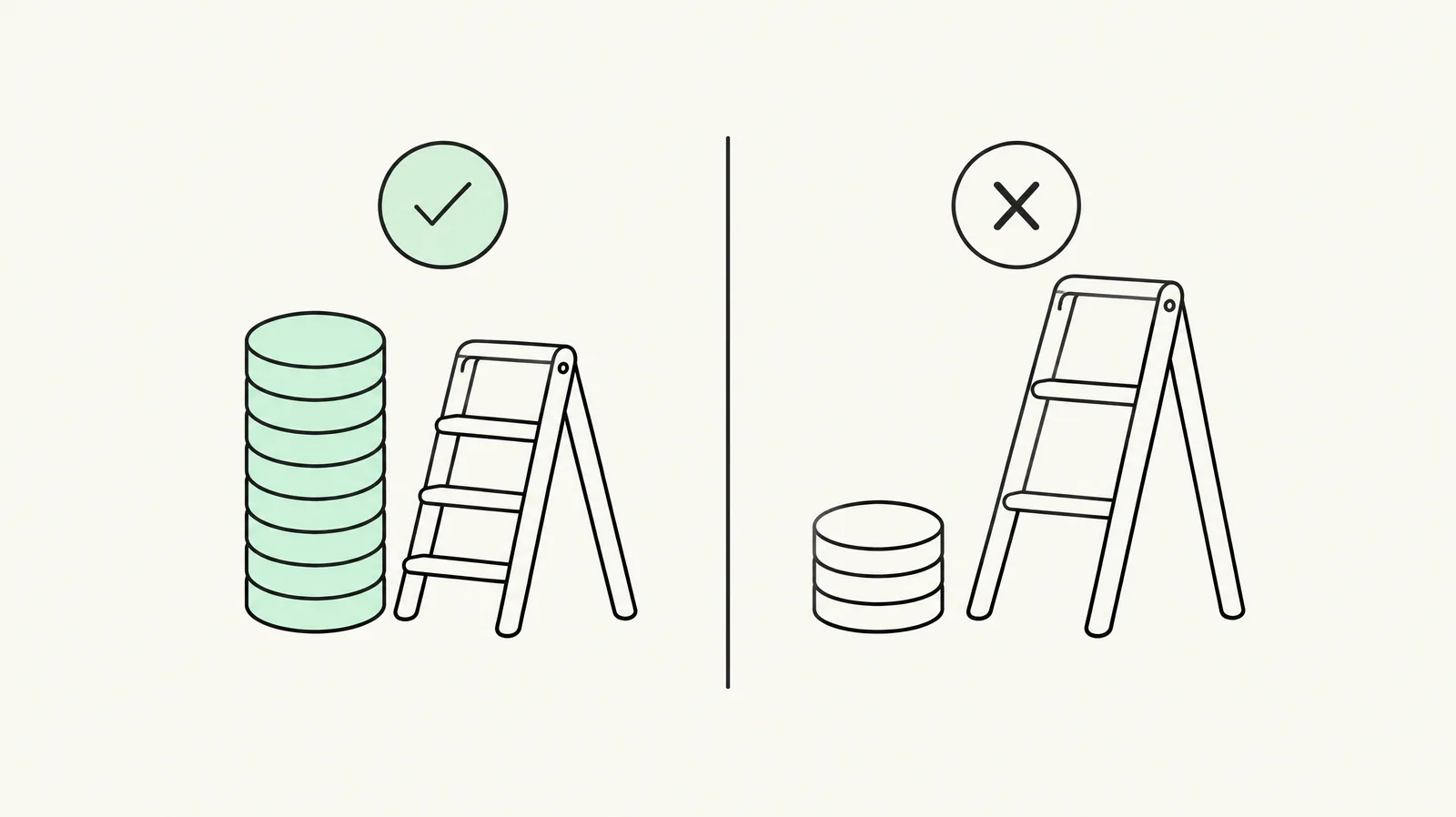
- First tier one step above modal quantity. Modal = 1 → tiers at 2/3. Modal = 2 (consumables) → tiers at 3/6. Starting at the quantity shoppers already buy = pure rebate.
- Deepest tier clears contribution floor on every unit. Compute it, don't feel it. Our example: 10% was safe, 25% was not — the gap between them is exactly the space to A/B test inside.
- Steps big enough to be noticed. A 3% step doesn't change behavior; 5–10% steps do. Sub-5% steps belong in B2B ladders where buyers compute totals, not DTC impulse tiers.
- Match real consumption cycles. 2/4/6 or 3/6/12 for consumables; case sizes for B2B. A tier nobody naturally wants (5 units of serum) is decoration.
- Three tiers maximum on the product page — depth beyond that depresses mobile interaction.
Guardrails before launch
- Margin floor: the deepest tier's contribution per unit ≥ some floor (e.g. 25% of unit price). Written down before testing, so a "let's try 30% off" isn't decided at the whiteboard.
- Stack ceiling: tier + sitewide code + free shipping ≤ floor. Map discount combination rules — covered in the complete guide.
- Returns adjustment: bulk orders return more in categories like apparel; haircut the contribution model by your historical return rate.
- Ad-attribution check: if tier revenue isn't tracked separately by your app, you can't compute contribution per tier — pick tooling that reports it (comparison in our best quantity breaks apps roundup).
How to test the ladder
- One variable: current page vs one candidate ladder. Multi-tier-depth variations at once = a multivariate question, which needs traffic most DTC stores don't have.
- Primary metric: contribution profit per visitor (guards against the Ladder B trap).
- Diagnostics: tier mix, add-to-cart rate, refund rate, revenue per session.
- Duration: two full purchase cycles — weekly-cycle consumables need ~2 weeks; monthly-cycle categories need longer.
- Then iterate one step: if A won, test a version with tier 3 at −12% before touching tier 2.
Running this as a standing program — baseline audit → ladder design → build → test → iterate — is the core of our Shopify CRO service; the same math applies whether you run it in-house or with us.
Last updated: November 16, 2026. Worked example uses illustrative unit economics; run the math on your own COGS, fulfillment and quantity mix before launching tiers.
Want this set up on your store?
Book a free 20-minute strategy call. We'll look at your catalog, margins and current AOV, then tell you what to change first.
Book a free strategy callFrequently asked questions
How deep should quantity-break discounts be?
Deep enough to change behavior (5–10% steps), never past contribution margin on every unit. In our worked example, −5%/−10% was profitable and −15%/−25% lost money despite higher AOV — the right depth depends entirely on your unit economics.
Should the biggest discount be at the highest tier?
Yes — depth must scale with quantity, or the ladder teaches shoppers the wrong behavior. But the highest tier still has to clear margin on all units, since the discount applies to the whole order.
Why did my AOV go up but profit go down after adding quantity breaks?
Classic case of the all-units rule: the discount applies to every unit in the order, so deep tiers donate margin on units shoppers would have bought at full price. Evaluate ladders on contribution profit per visitor, not AOV.
What's a good first quantity-break ladder?
For a consumable with 40%+ margins and modal quantity 1: Buy 2 at −5%, Buy 3 at −10%, with tier 2 or 3 labeled "Most Popular." Then A/B test depth from there with contribution-per-visitor as the metric.
Do quantity breaks hurt if shoppers already buy in bulk?
Yes — if most orders already hit tier 2, the tier is a rebate on existing behavior. Set the first break one step above your modal order quantity.