The ecommerce growth glossary
107 terms that show up in Shopify strategy calls, ad reports and CRO audits, defined in plain English. 26 include the formula, and every entry has its own link you can share.
Conversion Optimization · Metrics & Analytics · Paid Media · SEO & AI Search · Shopify & Ecommerce Tech · Retention & Lifecycle · Creative & UGC
Showing 107 of 107 terms
A
A/B Testing
Conversion OptimizationA controlled experiment that splits traffic between a control (A) and a variant (B) to measure which performs better on a pre-defined metric. Valid tests fix the sample size and primary metric before launch.
Related:MVTStatistical SignificanceMDEA/B vs multivariate testing →
Abandoned Cart Flow
Retention & LifecycleAutomated messages sent to shoppers who added to cart or started checkout but didn't buy, typically starting within an hour. Usually one of a store's highest revenue-per-recipient flows.
Related:Cart Abandonment RateEmail Flows
Accelerated Checkout
Shopify & Ecommerce TechExpress payment buttons — Shop Pay, Apple Pay, Google Pay, PayPal — that prefill shipping and payment details so returning shoppers can buy in a tap or two.
Related:Shop PayCheckout Completion Rate
Add-to-Cart Rate (ATC rate)
Conversion OptimizationThe share of sessions in which a visitor adds at least one product to the cart. A low ATC rate usually points to product-page problems: weak imagery, unclear pricing, missing trust signals, or slow load.
ATC rate = Sessions with add-to-cart ÷ Total sessions × 100
Related:Funnel AnalysisPDP
Advantage+ Shopping Campaigns (ASC)
Paid MediaMeta's automated campaign type for ecommerce that consolidates prospecting and retargeting into one campaign with broad targeting, letting the algorithm find buyers. Creative volume and variety become the main lever.
Related:Broad TargetingCreative TestingDPAMeta Ads services →
AI Overviews
SEO & AI SearchGoogle's AI-generated answer summaries shown above organic results, with links to cited sources. Being cited requires clear, quotable, well-structured content on a crawlable page.
AI UGC
Creative & UGCUGC-style ad video produced with AI avatars, voices, or editing instead of — or alongside — human creators. It lets brands test many hooks and scripts quickly at lower cost.
Attribution Model
Metrics & AnalyticsThe rule for assigning credit for a conversion to the touchpoints that preceded it — last click, first click, linear, time decay, or data-driven. Each ad platform attributes in its own favor, so platform totals usually add up to more than actual sales.
Attribution Window
Metrics & AnalyticsThe period after an ad click or view during which a conversion is credited to that ad — for example Meta's default of 7-day click, 1-day view. Changing the window changes reported ROAS without changing real results.
Related:Attribution ModelROAS
Average Order Value (AOV)
Metrics & AnalyticsThe average revenue per order. Raising AOV through bundles, upsells, and thresholds increases revenue without needing more traffic.
AOV = Revenue ÷ Number of orders
Example: $48,000 revenue from 800 orders = $60 AOV.
Related:Upsell & Cross-SellProduct BundleFree Shipping ThresholdRPV
B
Backlink
SEO & AI SearchA link from another website to yours. Relevant links from trusted sites remain one of the strongest signals search engines use to judge authority.
Related:KDInternal Linking
Bounce Rate
Conversion OptimizationIn GA4, the share of sessions that were not 'engaged' (under 10 seconds, no conversion, and only one page view). It is the inverse of engagement rate — a different definition from Universal Analytics' single-page-session bounce rate.
Bounce rate = 1 − Engagement rate
Break-Even ROAS
Paid MediaThe ROAS at which ad spend exactly equals the margin it generates — below it, every sale loses money. It is the floor every campaign target should be set above.
Break-even ROAS = 1 ÷ Contribution margin %
Example: At a 40% margin, break-even ROAS = 1 ÷ 0.40 = 2.5×.
Related:ROASContribution MarginPOASBreak-even ROAS guide + calculator →
Broad Targeting
Paid MediaRunning ads with few or no interest or demographic restrictions and letting the platform's algorithm decide who sees them. On Meta and TikTok, broad targeting shifts the job of finding the audience from targeting settings to the creative itself.
Related:ASCLookalike Audience
Buy Now, Pay Later (BNPL)
Shopify & Ecommerce TechC
CAC Payback Period
Metrics & AnalyticsHow long it takes for a customer's cumulative gross profit to cover what you paid to acquire them. Shorter payback means less cash tied up in growth.
Payback (months) = CAC ÷ Monthly gross profit per customer
Related:CACLTV:CAC Ratio
Call to Action (CTA)
Conversion OptimizationThe prompt that tells a visitor what to do next — 'Add to cart', 'Start free trial'. Effective CTAs are specific, visually dominant, and placed where the decision is actually made.
Related:Landing PageSticky Add-to-Cart
Canonical Tag
SEO & AI SearchAn HTML hint (rel="canonical") telling search engines which URL is the preferred version of duplicate or near-duplicate content. On Shopify it matters because products are reachable at both /products/x and /collections/y/products/x.
Related:Duplicate ContentEcommerce SEO
Cart Abandonment Rate
Conversion OptimizationThe percentage of shoppers who add items to a cart but leave without buying. Unexpected costs at checkout, forced account creation, and slow or confusing checkouts are the most commonly cited causes.
Cart abandonment = 1 − (Completed orders ÷ Carts created) × 100
Related:Checkout Completion RateAbandoned Cart FlowCart DrawerCheckout optimization →
Cart Drawer (slide cart)
Conversion OptimizationA cart that slides in over the current page instead of navigating to /cart. It keeps shoppers in context and is a common surface for upsells, free-shipping progress bars, and trust badges.
Related:Upsell & Cross-SellFree Shipping ThresholdCart Abandonment RateCartDrawer by Conversion →
Checkout Completion Rate
Conversion OptimizationThe share of shoppers who start checkout and finish an order. Because these users have already shown strong intent, small gains here translate almost directly into revenue.
Checkout completion = Orders ÷ Checkouts initiated × 100
Related:Cart Abandonment RateOne-Page CheckoutAccelerated CheckoutCheckout optimization →
Checkout Extensibility
Shopify & Ecommerce TechShopify's upgrade-safe framework for customizing checkout with UI extensions, Functions, and pixels. It replaced checkout.liquid, which Shopify has deprecated.
Related:Shopify PlusShopify FunctionsOne-Page CheckoutCheckout optimization →
Churn Rate
Retention & LifecycleThe share of customers or subscribers who stop buying in a period. For subscriptions, it's the single biggest driver of LTV.
Churn rate = Customers lost in period ÷ Customers at start of period × 100
Click-Through Rate (CTR)
Paid MediaThe share of people who saw an ad or search listing and clicked it. CTR measures how well the creative or snippet earns attention — not whether the click converts.
CTR = Clicks ÷ Impressions × 100
Related:CPMThumb-Stop RateMessage Match
Cohort Analysis
Retention & LifecycleGrouping customers by when they first purchased and tracking their behavior over time. It shows whether newer customers retain better or worse than older ones — something blended averages hide.
Related:Repeat Purchase RateChurn Rate
Collection Page SEO
SEO & AI SearchOptimizing Shopify collection (category) pages to rank for broad commercial queries such as 'women's running shoes'. Collections usually capture far more search demand than individual products.
Contribution Margin
Metrics & AnalyticsRevenue minus all variable costs of fulfilling an order — COGS, shipping, payment fees, and variable marketing. It is the profit each order contributes toward fixed costs, and the right basis for setting ROAS targets.
Contribution margin = Revenue − COGS − Shipping − Payment fees − Variable ad spend
Related:Break-Even ROASGross Margin
Conversion Rate (CVR)
Conversion OptimizationThe percentage of sessions (or users) that complete a goal. Always check the denominator: session-based and user-based conversion rates can differ substantially for the same store.
Conversion rate = Conversions ÷ Sessions × 100
Example: 120 orders from 6,000 sessions = 2.0% conversion rate.
Conversion Rate Optimization (CRO)
Conversion OptimizationThe practice of increasing the share of visitors who complete a desired action — usually a purchase — by removing friction, clarifying value, and testing changes against real behavior. Good CRO is a research-and-testing loop, not a list of best-practice tweaks.
Related:CVRA/B TestingFunnel AnalysisWhat is CRO? (full guide) →
Conversions API (CAPI)
Paid MediaMeta's server-to-server connection for sending purchase and funnel events directly from your store, alongside the browser pixel. It improves event match quality and therefore ad optimization.
Related:Server-Side TrackingAttribution ModelMeta Ads services →
Core Web Vitals (CWV)
SEO & AI SearchGoogle's user-experience metrics: Largest Contentful Paint (loading), Interaction to Next Paint (responsiveness), and Cumulative Layout Shift (visual stability). Heavy apps and unoptimized images are the usual culprits on Shopify.
Related:Page SpeedShopify development →
Cost per Acquisition (CPA)
Paid MediaCost per Click (CPC)
Paid MediaThe average amount paid each time someone clicks an ad. CPC is set by auction competition, bid strategy, and ad quality.
CPC = Ad spend ÷ Clicks
Related:PPCCTRQuality Score
Cost per Mille (CPM)
Paid MediaCrawl Budget
SEO & AI SearchHow many URLs a search engine will crawl on your site in a given period. Large catalogs with faceted filters can burn it on low-value URLs, leaving new pages undiscovered.
Related:Duplicate ContentXML Sitemap
Creative Fatigue
Paid MediaThe decline in an ad's performance as the same audience sees it repeatedly — rising frequency, falling CTR, rising CPA. The fix is a steady pipeline of new creative, not just new targeting.
Related:Creative TestingFrequency
Creative Testing
Creative & UGCSystematically launching new ad concepts, angles, hooks, and formats to find winners and fight fatigue. On algorithm-driven platforms, creative is now the main targeting lever.
Customer Acquisition Cost (CAC)
Metrics & AnalyticsThe average cost to acquire one new customer. 'Blended' CAC divides all marketing spend by all new customers; 'paid' CAC uses only paid-media spend and the customers it acquired.
CAC = Marketing spend ÷ New customers acquired
Customer Lifetime Value (CLV / LTV)
Metrics & AnalyticsThe total gross profit (or revenue) a customer is expected to generate over their relationship with your brand. Measure it on margin, not revenue, when comparing it to acquisition cost.
Simple LTV = AOV × Purchase frequency × Gross margin × Customer lifespan
Related:CACLTV:CAC RatioRepeat Purchase RateRetention & lifecycle services →
D
Duplicate Content
SEO & AI SearchSubstantially identical content at multiple URLs — variant URLs, filtered collections, manufacturer descriptions copied across stores. It splits ranking signals and wastes crawl budget.
Related:Canonical TagCrawl Budget
Dynamic Product Ads (DPA)
Paid MediaCatalog-powered ads that automatically show each person the products they viewed or similar items, pulled from your product feed.
Related:Product FeedRetargeting
E
Ecommerce SEO
SEO & AI SearchOptimizing an online store's collection pages, product pages, and content so they rank in organic search. It leans heavily on site architecture, faceted-navigation control, structured data, and commercial-intent keywords.
Related:Collection Page SEOStructured DataCanonical TagShopify SEO services →
Email Flows (automations)
Retention & LifecycleTriggered email or SMS sequences sent automatically based on behavior — welcome, browse abandonment, abandoned cart, post-purchase, win-back. They run continuously, unlike one-off campaigns.
Related:Abandoned Cart FlowWelcome SeriesWin-Back FlowRetention & lifecycle services →
Engagement Rate (GA4)
Metrics & AnalyticsThe share of sessions that lasted 10+ seconds, had a conversion event, or had two or more page views. It replaced bounce rate as GA4's headline quality metric.
Engagement rate = Engaged sessions ÷ Sessions × 100
Related:Bounce Rate
F
Featured Snippet
SEO & AI SearchA highlighted answer extracted from a page and shown at the top of Google results. Short, direct definitions and step lists right under a matching heading earn them most often.
Related:AI OverviewsSERP
Free Shipping Threshold
Conversion OptimizationThe minimum cart value that unlocks free shipping. Set slightly above current AOV, it nudges shoppers to add one more item; set too high, it becomes an abandonment trigger.
Related:AOVCart Drawer
Frequency
Paid MediaThe average number of times each person in your audience has seen an ad over a period.
Frequency = Impressions ÷ Reach
Related:Creative FatigueCPM
Funnel Analysis
Conversion OptimizationMeasuring how many users progress through each step toward purchase — typically session → product view → add to cart → checkout → order — to find the step with the largest avoidable drop-off.
Related:Add-to-Cart RateCart Abandonment RateCheckout Completion RateShopify CRO services →
G
Generative Engine Optimization (GEO / AEO)
SEO & AI SearchOptimizing content so AI assistants — ChatGPT, Perplexity, Gemini, Google AI Overviews — find, trust, and cite your brand in their answers. It favors concise definitions, original data, and consistent brand mentions across the web.
Related:AI OverviewsStructured DataSEO & AI search services →
Google Shopping
Paid MediaProduct listing ads that show an image, price, and store name directly in Google results, generated from a product feed in Google Merchant Center rather than from keywords you write.
Gross Margin
Metrics & AnalyticsThe share of revenue left after the direct cost of the goods sold. Gross margin sets the ceiling on how much you can spend to acquire a sale.
Gross margin = (Revenue − COGS) ÷ Revenue × 100
H
Headless Commerce
Shopify & Ecommerce TechSeparating the storefront (front end) from the commerce engine (back end) and connecting them by API. It allows fully custom, fast front ends at the cost of more engineering.
Related:Shopify Hydrogen
Heatmap
Conversion OptimizationA visual overlay showing where users click, move, or scroll on a page. Heatmaps reveal what visitors actually notice — and ignore — and are a common input when forming test hypotheses.
Related:Session RecordingFunnel Analysis
Hook
Creative & UGCThe first one to three seconds of a video ad, designed to stop the scroll. Testing new hooks on a proven ad body is one of the cheapest ways to extend a winning creative.
Related:Thumb-Stop RateCreative Testing
I
Incrementality
Metrics & AnalyticsThe sales that would not have happened without a given campaign. Measured with holdout or geo-lift tests, it separates ads that cause purchases from ads that merely take credit for them.
Related:Attribution ModelMER
Internal Linking
SEO & AI SearchLinks between pages on your own site. They help search engines discover pages, understand topical relationships, and distribute authority to the collections and products you most want to rank.
Related:Collection Page SEOBacklink
K
Keyword Difficulty (KD)
SEO & AI SearchA tool-specific score estimating how hard it is to rank in the top 10 for a keyword, mostly based on the backlink strength of pages already ranking. Scores aren't comparable across tools.
Related:Search IntentBacklink
L
Landing Page
Conversion OptimizationThe first page a visitor sees from a campaign or search result. High-converting landing pages match the promise of the ad or query that sent the visitor, keep one primary call to action, and answer objections above the fold.
Lookalike Audience
Paid MediaAn audience the ad platform builds from people who resemble a seed list, such as your best customers. Useful for prospecting, though broad targeting has replaced it in many accounts.
Related:Broad TargetingRetargeting
LTV:CAC Ratio
Metrics & AnalyticsCompares what a customer is worth to what it cost to acquire them. It tells you how aggressively you can afford to spend on acquisition while staying profitable.
LTV:CAC = Customer lifetime value ÷ Customer acquisition cost
M
Marketing Efficiency Ratio (MER)
Metrics & AnalyticsTotal store revenue divided by total marketing spend. Also called blended ROAS, MER sidesteps platform attribution disputes by looking at the whole business.
MER = Total revenue ÷ Total marketing spend
Related:ROASAttribution Model
Message Match
Conversion OptimizationHow closely a landing page's headline, offer, and visuals repeat what the ad or email promised. Poor message match makes visitors feel they landed in the wrong place and is a common cause of paid traffic bouncing.
Related:Landing PageCTR
Metafields & Metaobjects
Shopify & Ecommerce TechCustom data fields attached to products, collections, customers, and more (metafields), and reusable custom content types (metaobjects). They power size charts, ingredient lists, and comparison tables without hard-coding.
Related:PDPShopify development →
Minimum Detectable Effect (MDE)
Conversion OptimizationThe smallest relative lift a test is designed to reliably detect. Lower MDEs need much larger samples, which is why low-traffic stores should test bold changes rather than button colors.
Multivariate Testing (MVT)
Conversion OptimizationA test that changes several page elements at once and measures every combination to find which elements — and which interactions between them — drive results. It needs far more traffic than an A/B test to reach significance.
Related:A/B TestingStatistical SignificanceA/B vs multivariate testing →
O
One-Page Checkout
Shopify & Ecommerce TechA checkout that collects contact, shipping, and payment on a single screen instead of separate steps. Shopify now uses a one-page layout by default.
P
Page Speed
Shopify & Ecommerce TechHow quickly a page loads and becomes usable. On Shopify, the biggest drags are usually unused app scripts, oversized images, and render-blocking third-party tags.
Pay-per-Click (PPC)
Paid MediaAn ad model in which you pay only when someone clicks. In ecommerce it usually refers to Google Search and Shopping, Microsoft Ads, and Amazon Sponsored Products.
Performance Max (PMax)
Paid MediaA Google Ads campaign type that serves across Search, Shopping, YouTube, Display, Gmail, Maps, and Discover from one set of assets, letting Google's automation choose placements and bids. It needs clean conversion data and brand exclusions to avoid cannibalizing branded search.
Related:Google ShoppingProduct FeedPPCEcommerce PPC services →
Post-Purchase Upsell
Retention & LifecycleA one-click offer shown after payment but before the thank-you page. Because payment details are already captured, accepting doesn't put the original order at risk.
Product Bundle
Retention & LifecycleTwo or more products sold together, often at a small discount. Bundles raise AOV and help move slower inventory alongside bestsellers.
Related:AOVUpsell & Cross-Sell
Product Detail Page (PDP)
Shopify & Ecommerce TechThe individual product page. It carries most of the persuasion load — imagery, price, variants, reviews, shipping info, and the add-to-cart button.
Related:Add-to-Cart RateSticky Add-to-CartSocial ProofShopify CRO services →
Product Feed
Paid MediaA structured file of your catalog — titles, prices, images, GTINs, availability — that powers Shopping ads, Meta catalog ads, and marketplaces. Feed quality (especially titles) directly affects which searches your products show for.
Related:Google ShoppingDPA
Profit on Ad Spend (POAS)
Paid MediaGross profit from ad-driven sales divided by ad spend. Feeding profit instead of revenue into bidding pushes budget toward high-margin products.
POAS = (Attributed revenue − COGS) ÷ Ad spend
Related:ROASBreak-Even ROAS
Q
Quality Score
Paid MediaGoogle's 1–10 diagnostic rating of a keyword based on expected CTR, ad relevance, and landing page experience. Higher relevance tends to lower your CPC for the same position.
Related:CPCLanding PageMessage Match
R
Repeat Purchase Rate
Retention & LifecycleThe share of customers who have ordered more than once in a given period. It's the clearest early indicator of product-market fit and lifetime value.
Repeat purchase rate = Customers with 2+ orders ÷ Total customers × 100
Related:Customer Lifetime ValueCohort AnalysisRetention & lifecycle services →
Replatforming
Shopify & Ecommerce TechMigrating a store from one ecommerce platform to another — for example WooCommerce or Magento to Shopify. The riskiest parts are URL redirects, data integrity, and preserving SEO rankings.
Related:Canonical TagEcommerce SEOShopify migration services →
Retargeting (remarketing)
Paid MediaShowing ads to people who already visited your site, viewed a product, or added to cart. Retargeting audiences convert well but are small and heavily over-credited by last-click attribution.
Related:DPAIncrementality
Return on Ad Spend (ROAS)
Paid MediaRevenue attributed to ads divided by what those ads cost. ROAS is a revenue ratio, not a profit measure — a 3× ROAS can lose money if margins are thin.
ROAS = Attributed revenue ÷ Ad spend
Example: $15,000 attributed revenue on $5,000 spend = 3.0× ROAS.
Revenue per Visitor (RPV)
Metrics & AnalyticsRFM Segmentation
Retention & LifecycleScoring customers by Recency (last purchase), Frequency (number of orders), and Monetary value (spend) to target VIPs, at-risk buyers, and lapsed customers differently.
Related:Cohort AnalysisWin-Back Flow
Rich Results
SEO & AI SearchEnhanced search listings — star ratings, price, availability, breadcrumbs — powered by structured data. They don't directly improve rankings but often improve click-through rate.
Related:Structured DataCTR
S
Search Engine Results Page (SERP)
SEO & AI SearchThe page a search engine returns for a query. Modern ecommerce SERPs mix organic links, Shopping ads, free product listings, AI Overviews, and 'People also ask' boxes.
Search Intent
SEO & AI SearchServer-Side Tracking
Metrics & AnalyticsSending conversion events from your server to ad platforms (e.g. Meta Conversions API, Google enhanced conversions) instead of relying only on the browser pixel. It recovers events lost to ad blockers and browser privacy limits.
Related:CAPIAttribution Model
Session Recording
Conversion OptimizationA replay of an individual visitor's clicks, scrolls, and taps. Watching recordings of users who dropped off is one of the fastest ways to spot broken UI, confusing copy, or rage clicks.
Related:Heatmap
Shop Pay
Shopify & Ecommerce TechShopify's accelerated checkout that stores a shopper's details across every Shopify store using it, and offers installment payments via Shop Pay Installments.
Related:Accelerated CheckoutBNPL
Shopify B2B
Shopify & Ecommerce TechNative wholesale features on Shopify Plus: company accounts, customer-specific price lists, quantity rules, payment terms, and net invoicing within the same store.
Shopify Functions
Shopify & Ecommerce TechCustom backend logic that runs inside Shopify's infrastructure to change discounts, shipping, payment options, and cart validation — the replacement for Shopify Scripts.
Related:Checkout ExtensibilityShopify PlusShopify app development →
Shopify Hydrogen
Shopify & Ecommerce TechShopify's React-based framework for building headless storefronts, typically hosted on Shopify's Oxygen platform.
Shopify Plus
Shopify & Ecommerce TechShopify's enterprise plan, adding checkout extensibility, Shopify Functions, B2B features, expansion stores, and higher API limits for high-volume merchants.
Related:Checkout ExtensibilityShopify FunctionsShopify B2BShopify Plus pricing guide →
Shoppable Video
Creative & UGCVideo content with tagged products that shoppers can view or buy without leaving the video — on-site, in social feeds, or in live streams.
Statistical Significance
Conversion OptimizationHow unlikely a test result would be if there were truly no difference between variants. A 95% significance threshold means accepting a 5% chance of a false positive. Stopping a test the moment it 'hits significance' inflates that error rate.
Related:A/B TestingMDE
Sticky Add-to-Cart
Conversion OptimizationAn add-to-cart bar that stays visible as the shopper scrolls a product page, most often on mobile, so the buy action is always one tap away.
Related:Add-to-Cart RatePDP
Structured Data (schema markup)
SEO & AI SearchCode (usually JSON-LD using Schema.org vocabulary) that labels page content for machines — Product, Offer, Review, FAQ, Breadcrumb. It enables rich results such as price and star ratings in search.
Related:Rich ResultsEcommerce SEO
Subscription Commerce
Retention & LifecycleSelling products on a recurring schedule (subscribe-and-save, replenishment, memberships). It smooths revenue and raises LTV when churn is controlled.
T
Theme App Extension
Shopify & Ecommerce TechThe way Shopify apps add blocks to Online Store 2.0 themes without editing theme code, so apps can be removed cleanly without leftover code slowing the store.
Related:CWV
Thumb-Stop Rate (hook rate)
Creative & UGCTrust Signals
Conversion OptimizationPage elements that reassure shoppers the store is legitimate and the purchase is safe: clear return policies, secure payment badges, recognizable payment methods, contact details, and reviews.
U
Upsell & Cross-Sell
Retention & LifecycleAn upsell offers a higher-value version of what the shopper is buying; a cross-sell offers a complementary product. Both are common on product pages, in cart drawers, and post-purchase.
User-Generated Content (UGC)
Creative & UGCPhotos, videos, and reviews made by customers or creators rather than the brand. In paid social, 'UGC' usually means creator-made ads styled to feel native to the feed.
Related:Social ProofAI UGCCreative TestingWhat is UGC video? →
W
Welcome Series
Retention & LifecycleThe first flow a new subscriber receives, introducing the brand, delivering any sign-up offer, and handling objections before the first purchase.
Related:Email Flows
Win-Back Flow
Retention & LifecycleMessages aimed at customers who haven't purchased in longer than your typical repurchase cycle, designed to reactivate them before they lapse for good.
Related:RFM SegmentationChurn Rate
X
XML Sitemap
SEO & AI SearchA file listing the URLs you want search engines to find, with optional last-modified dates. Shopify generates one automatically at /sitemap.xml.
Related:Crawl Budget
Z
Zero-Party Data
Retention & LifecycleInformation customers intentionally share — quiz answers, preferences, birthdays, product interests. It enables personalization without relying on third-party tracking.
Related:RFM SegmentationEmail Flows
Know the terms, but not where your store is leaking revenue?
We audit your funnel, ad accounts, and margins, then show you which of these metrics to move first.
30-minute call · No commitment · Custom quote in 48 hours
Frequently asked questions
What's the difference between ROAS and MER?
ROAS divides the revenue an ad platform attributes to its own ads by that platform's spend. MER divides your store's total revenue by total marketing spend. ROAS is useful for comparing campaigns within a platform; MER is the more honest view of whether marketing as a whole is paying off, because it isn't affected by attribution double-counting.
How do I calculate break-even ROAS?
Divide 1 by your contribution margin as a decimal. If 40% of each sale's revenue is left after product cost, shipping, and payment fees, your break-even ROAS is 1 ÷ 0.40 = 2.5×. Any campaign below that loses money on the first order.
Which ecommerce metric should I focus on first?
Start with contribution margin and revenue per visitor. Contribution margin tells you how much you can afford to pay for a customer; revenue per visitor combines conversion rate and AOV, so it captures the effect of most site changes in one number.
Is a glossary page good for SEO?
Yes, when every term has a unique anchor, a direct definition, and links to deeper pages. Definitions written as one-to-two-sentence answers are the format search features and AI assistants most often quote.

Social Commerce
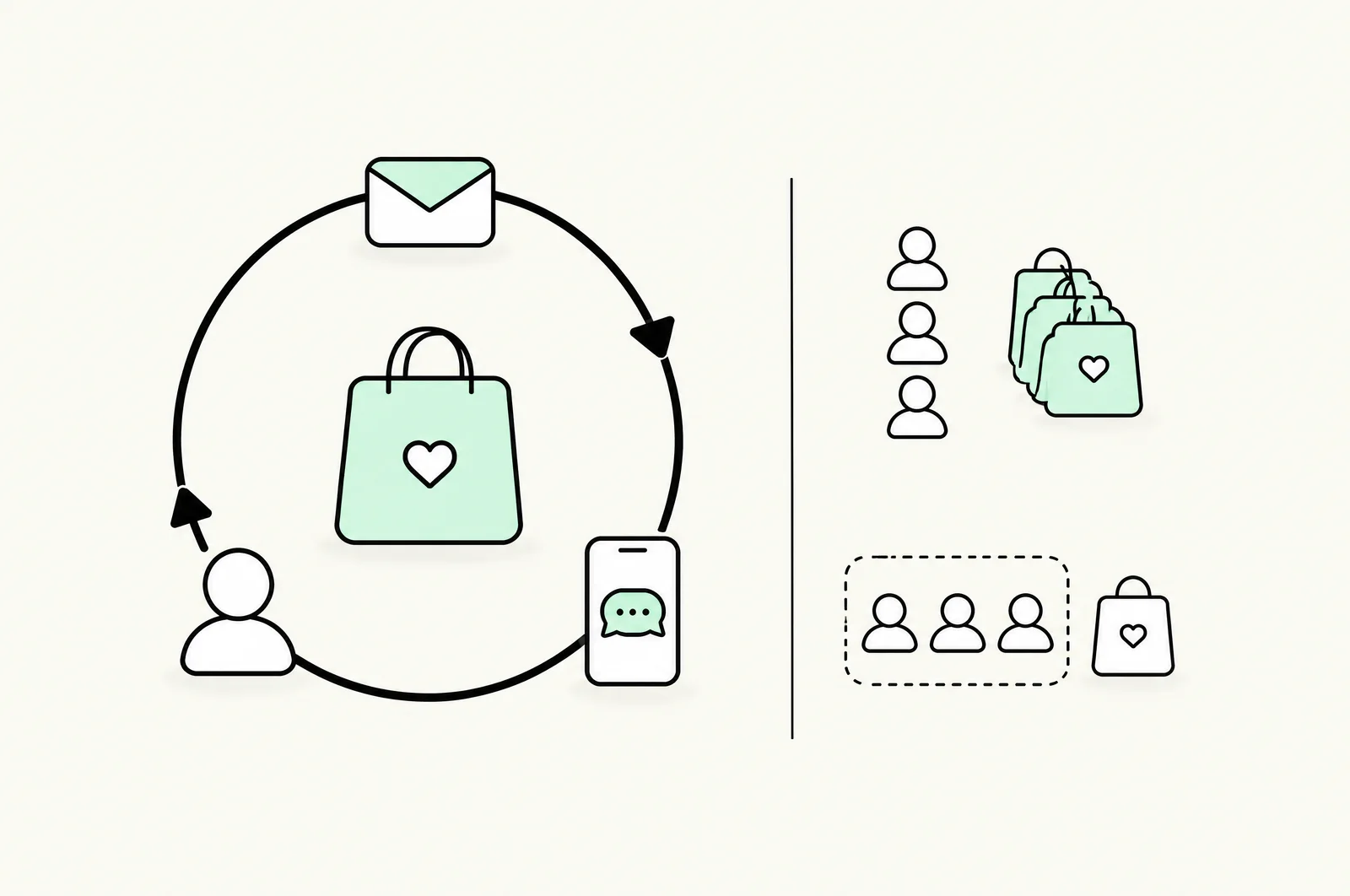
Creative & UGCSelling directly inside social platforms — TikTok Shop, Instagram and Facebook Shops — where discovery and checkout happen in the same app.
Related:Shoppable VideoSocial commerce on Shopify →