What ads actually cost
Built from $100M+ of ad spend we have managed across Meta, Google, TikTok. Not a survey, not a range someone else published — the auction mechanics that set your price, and the arithmetic that tells you the minimum you can spend to learn anything.
$100M+ managed spend · 3 platforms · USD · checked
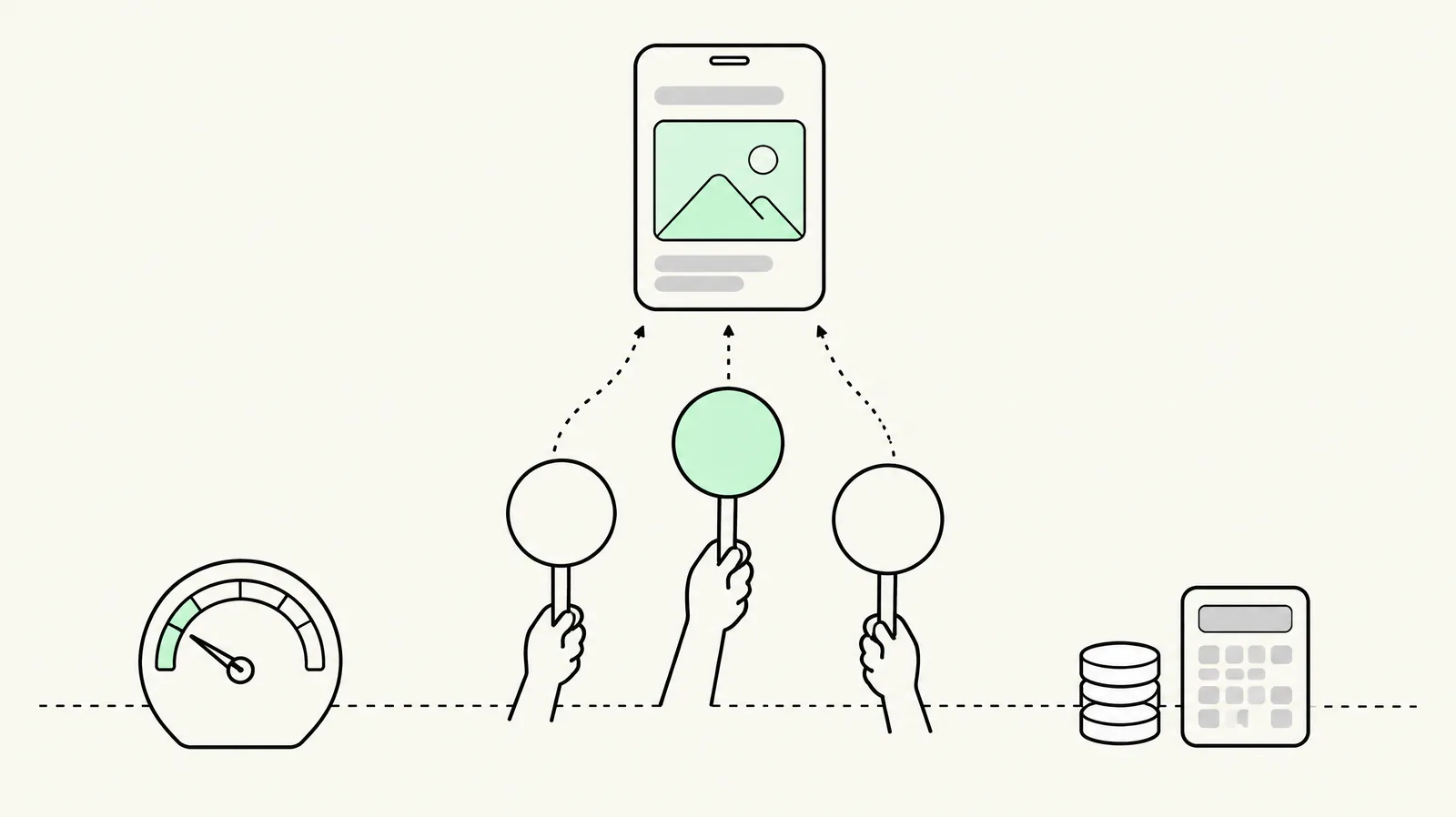
There is no single price for advertising on Facebook, Google or TikTok. Each platform runs an auction, so your cost is set by who else is bidding for the same person at the same moment. What you can control is the floor — the daily budget your target cost per result requires — and the efficiency of the page the ad sends people to.
- · Cost per result is decided by the auction, not by your bid alone.
- · A $5/day budget buys roughly one purchase every eight days at a $40 target CPA — too few to leave the learning phase.
- · Maximum affordable CPA = average order value × contribution margin.
The floor: how little you can spend and still learn
Budget questions are arithmetic, not opinion. Four rules cover almost every one we get asked. Each takes your own numbers, so the answer is correct for you rather than an average that belongs to someone else.
- Learning-phase floor
target CPA × 50 ÷ 7The daily budget that gives an ad set ~50 optimisation events inside a week — the threshold to exit learning on Meta.
At a $40 target CPA: 40 × 50 ÷ 7 ≈ $285/day.
- Statistical floor for a test
target CPA × 100 ÷ test length in daysDoubles the learning threshold so a creative or offer test has enough conversions to read, not just enough to deliver.
At a $40 target CPA over 14 days: 40 × 100 ÷ 14 ≈ $285/day.
- Break-even ceiling
AOV × contribution margin % = max CPAThe most you can pay for a customer before the sale stops making money. Everything above this is a loss you chose.
At a $90 AOV and 45% contribution: max CPA = $40.50.
- Is $5 a day enough?
daily ÷ target CPA = events per dayFor most ecommerce targets, no. $5 at a $40 CPA buys 0.125 conversions a day — one purchase every eight days, which never exits learning.
$5 ÷ $40 = 0.125 events/day.
What sets the price on each platform
The same creative, audience and budget produces three different costs per result, because the three auctions are not the same auction. Here is what actually moves the number on each.
Facebook & Instagram (Meta)
Metric that matters: Cost per result (CPA), not CPC
The auction is not won on bid alone
Meta ranks ads by an estimate of total value: your bid, multiplied by its prediction that the person will act, plus an adjustment for ad quality and expected engagement. A higher bid loses to a cheaper, better-predicted ad. This is why raising the budget does not lower your cost per result on its own.
Objective changes the price you see
The same audience and creative has a different reported CPC depending on whether you optimise for clicks, landing page views, or purchases. Optimising for clicks buys cheap clicks from people unlikely to buy, which is why a low CPC and a high CPA arrive together.
Learning phase sets your floor
An ad set needs roughly 50 optimisation events in a rolling week to leave the learning phase. Below that, delivery is unstable and costs swing. Your realistic daily floor is your target cost per result multiplied by about seven, so the ad set can exit learning inside a week.
Q4 moves the clearing price
Auction competition is seasonal. The same placement costs more in November than in February because more advertisers are bidding for the same inventory. Budgets planned on annual averages under-deliver in Q4.
Google Ads
Metric that matters: Cost per acquisition against margin
Search price is set by the advertiser behind you
On Search you pay roughly the minimum needed to hold your position above the next advertiser, adjusted by Quality Score. You are not paying your maximum bid. Improving ad relevance and landing page experience lowers what you pay for the same position.
Intent segments price very differently
Brand, high-intent non-brand, and generic category terms behave like three separate auctions. Brand is cheap and converts; generic is expensive and does not. Blended cost per conversion hides which of the three is actually unprofitable.
Performance Max hides the split
Performance Max reports one blended cost per conversion across every channel it touches, including branded search it would have won anyway. Treat its reported CPA as an upper bound on incrementality, not a cost of acquisition.
Quality Score is a discount, not a score
Expected CTR, ad relevance and landing page experience combine into a discount on the price you pay for a given position. It is the only lever in the auction that a better page can move without more budget.
TikTok Ads
Metric that matters: Cost per 1,000 impressions (CPM), then CPA
Cheap impressions, expensive discipline
TikTok usually clears at a lower CPM than Meta for the same audience. The saving is real, but it arrives with higher creative churn: an ad that worked two weeks ago can stop working as the audience tires of it, and there is no relevance score to warn you first.
Creative volume is the real budget line
Because fatigue is fast, the constraint is how many new creatives you can ship per week, not how much you can spend. Budget spent past your creative capacity buys frequency against a tired ad.
Campaign minimums raise the entry price
TikTok's published minimum is $50 a day per campaign and $20 a day per ad group, against Meta's $1 and no fixed floor on Google, so the platform is a poor place to run a $5-a-day test. Test on it only once you have creative that already works elsewhere.
Spark Ads change the economics
Running through a creator's own handle borrows their engagement signal, which typically lowers CPM against the same creative served from a brand account. Budget the usage rights alongside the media, because they are part of the true cost.
Method
- Sample
- $100M+ of cumulative managed spend across Meta, Google, TikTok.
- Source
- Figures are aggregated from ad accounts we manage, at the platform-reported level, in USD, before agency fees and excluding creative production. Platform-reported conversion counts are the platform's own attribution, so they overstate incrementality where a pixel fires on more than one channel.
- Currency
- USD, primarily Primarily US, CA, GB.
- Threshold
- A platform-metric pair is published only where the segment carries enough spend and conversion volume to be stable; below that we say nothing rather than publish noise.
- Excludes
- Agency fees, creative production, and any spend we did not manage.
- Last check
We have already lost the money on your behalf
You do not need to fund our education. We will scope your account, show you the CPA you should be paying, and quote against it. Pay-on-results, no retainer.
30-minute call · No commitment · Custom quote in 48 hours
Frequently asked questions
How much does it cost to advertise on Facebook, Google or TikTok?
There is no single price: each platform runs an auction, so your cost is set by who else is bidding for the same person at the same moment. What you can control is the floor — the daily budget your target cost per result requires — and the efficiency of the page the ad sends people to. Anything quoted as one flat number is an average across advertisers who share nothing in common with you.
Is $5 a day enough for Facebook ads?
It is enough to spend, not enough to learn. At a $40 target cost per purchase, $5 a day buys about one conversion every eight days, so the ad set never collects the ~50 events it needs to leave the learning phase. $5 a day is a reasonable first week to confirm tracking works; it is not a test.
What is a good cost per click?
A good CPC is one that supports your cost per acquisition, which is one that supports your margin. Work backwards: max CPA = average order value × contribution margin. Then CPC is only acceptable if your landing page converts well enough that CPC ÷ conversion rate stays under that ceiling. A $0.40 CPC is bad if your page converts at 1% and your ceiling is $30.
Why did my cost per click go up?
Four usual causes, in order: the auction got more expensive (seasonality or a competitor entering), your creative fatigued so engagement-driven discounts fell away, your audience narrowed until you were bidding against yourself, or you changed the optimisation objective. Check the objective and the audience size first — they are the two that change overnight without anyone touching the account.
Does a bigger budget lower my cost per result?
Not by itself. More budget buys more delivery, not better delivery. Cost per result falls when the ad's predicted value rises — better creative, a closer audience match, a faster landing page — or when you stop paying for objectives that do not lead to revenue. Scaling spend into a mediocre ad just buys more of the same CPA.
Where does this data come from?
Ad accounts we manage: $100M+ of cumulative spend across Meta, Google, TikTok, at the platform-reported level in USD. Platform-reported conversions use each platform's own attribution, so they overstate incrementality where more than one channel claims the same sale.