What Google Ads Actually Cost
On Google you pay roughly the minimum needed to hold your position above the next advertiser, adjusted by Quality Score. You almost never pay your maximum bid.
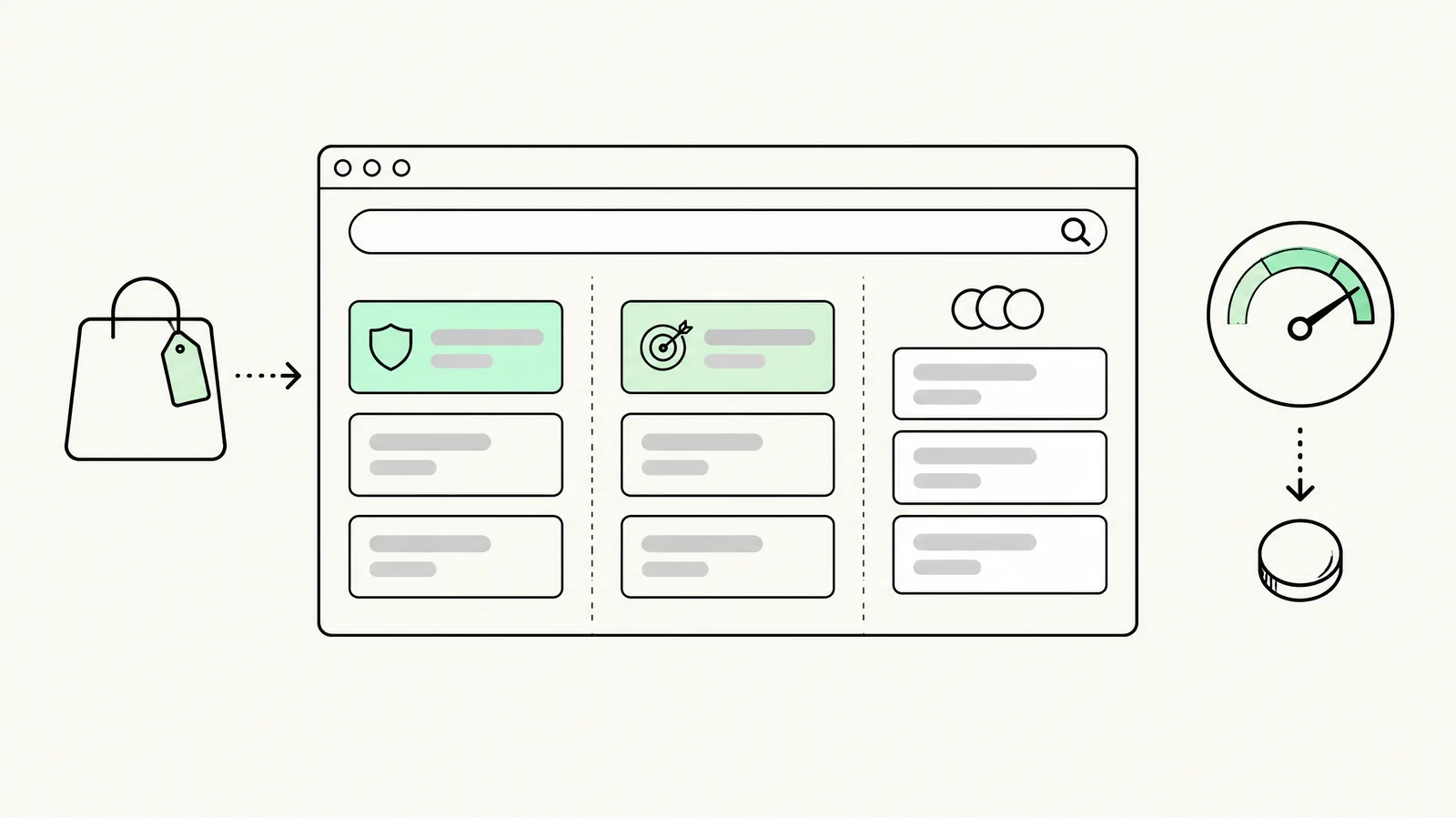
Google Ads cost is set by the advertiser behind you, discounted by Quality Score. Because brand, high-intent non-brand and generic terms behave like three separate auctions, a single blended cost per conversion hides which one is unprofitable — and Performance Max reports one blended figure across every channel it touches, including branded search you would have won anyway.
- · Improving ad relevance and landing page experience lowers what you pay for the same position.
- · Brand, high-intent and generic are separate auctions with completely different economics.
- · Performance Max's reported CPA is an upper bound on incrementality, not a cost of acquisition.
- · Segment cost per conversion by intent tier before deciding what to cut.
What sets the price
Search price is set by the advertiser behind you
On Search you pay roughly the minimum needed to hold your position above the next advertiser, adjusted by Quality Score. You are not paying your maximum bid. Improving ad relevance and landing page experience lowers what you pay for the same position.
Intent segments price very differently
Brand, high-intent non-brand, and generic category terms behave like three separate auctions. Brand is cheap and converts; generic is expensive and does not. Blended cost per conversion hides which of the three is actually unprofitable.
Performance Max hides the split
Performance Max reports one blended cost per conversion across every channel it touches, including branded search it would have won anyway. Treat its reported CPA as an upper bound on incrementality, not a cost of acquisition.
Quality Score is a discount, not a score
Expected CTR, ad relevance and landing page experience combine into a discount on the price you pay for a given position. It is the only lever in the auction that a better page can move without more budget.
Budget floors
The same four rules work on every platform, because they are arithmetic rather than platform policy. Substitute your own target cost per result.
- Learning-phase floor
target CPA × 50 ÷ 7The daily budget that gives an ad set ~50 optimisation events inside a week — the threshold to exit learning on Meta.
At a $40 target CPA: 40 × 50 ÷ 7 ≈ $285/day.
- Statistical floor for a test
target CPA × 100 ÷ test length in daysDoubles the learning threshold so a creative or offer test has enough conversions to read, not just enough to deliver.
At a $40 target CPA over 14 days: 40 × 100 ÷ 14 ≈ $285/day.
- Break-even ceiling
AOV × contribution margin % = max CPAThe most you can pay for a customer before the sale stops making money. Everything above this is a loss you chose.
At a $90 AOV and 45% contribution: max CPA = $40.50.
- Is $5 a day enough?
daily ÷ target CPA = events per dayFor most ecommerce targets, no. $5 at a $40 CPA buys 0.125 conversions a day — one purchase every eight days, which never exits learning.
$5 ÷ $40 = 0.125 events/day.
Method. Built from $100M+ of managed spend across Meta, Google, TikTok. Figures are aggregated from ad accounts we manage, at the platform-reported level, in USD, before agency fees and excluding creative production. Platform-reported conversion counts are the platform's own attribution, so they overstate incrementality where a pixel fires on more than one channel. Currency USD, primarily Primarily US, CA, GB. Last check . All platforms.