What Facebook Ads Actually Cost
Facebook does not sell inventory at a price. It runs an auction for every impression, so your cost per click and cost per result are outcomes of that auction rather than rates you can look up.
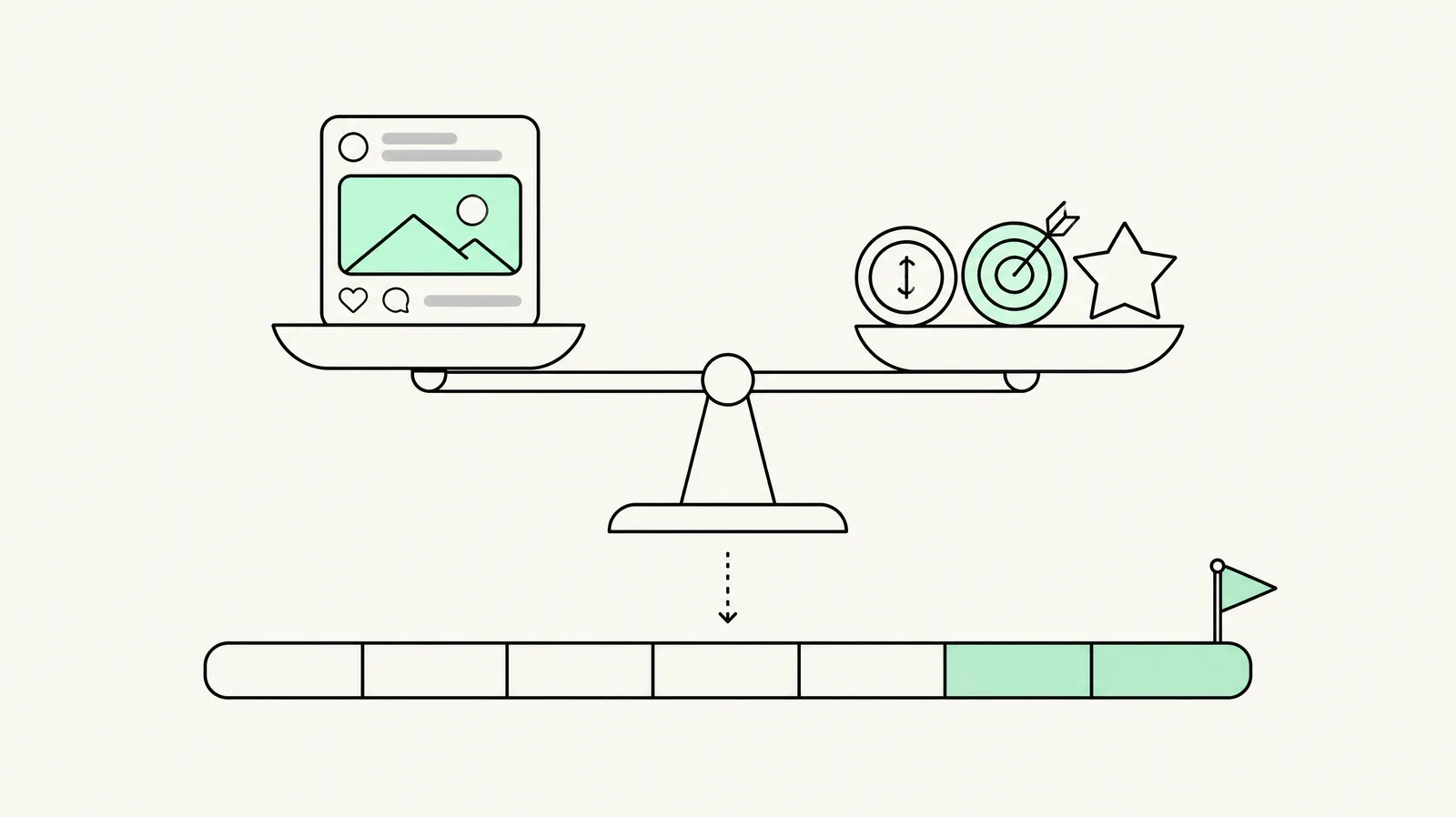
There is no fixed cost for Facebook ads. You pay roughly the minimum needed to hold your ranking in an auction that scores your bid, its predicted likelihood of action, and ad quality together. Because your own creative and audience change that score, the same budget can produce very different costs in two accounts — and in the same account two months apart.
- · A higher bid loses to a cheaper ad that Meta predicts will earn more attention.
- · Cost per result, not CPC, is the number to manage — a cheap click from someone who never buys is not cheap.
- · Your daily floor is roughly your target cost per result × 7, so the ad set can exit learning inside a week.
- · Q4 is more expensive for identical delivery; budgets built on annual averages under-deliver in November.
What sets the price
The auction is not won on bid alone
Meta ranks ads by an estimate of total value: your bid, multiplied by its prediction that the person will act, plus an adjustment for ad quality and expected engagement. A higher bid loses to a cheaper, better-predicted ad. This is why raising the budget does not lower your cost per result on its own.
Objective changes the price you see
The same audience and creative has a different reported CPC depending on whether you optimise for clicks, landing page views, or purchases. Optimising for clicks buys cheap clicks from people unlikely to buy, which is why a low CPC and a high CPA arrive together.
Learning phase sets your floor
An ad set needs roughly 50 optimisation events in a rolling week to leave the learning phase. Below that, delivery is unstable and costs swing. Your realistic daily floor is your target cost per result multiplied by about seven, so the ad set can exit learning inside a week.
Q4 moves the clearing price
Auction competition is seasonal. The same placement costs more in November than in February because more advertisers are bidding for the same inventory. Budgets planned on annual averages under-deliver in Q4.
Budget floors
The same four rules work on every platform, because they are arithmetic rather than platform policy. Substitute your own target cost per result.
- Learning-phase floor
target CPA × 50 ÷ 7The daily budget that gives an ad set ~50 optimisation events inside a week — the threshold to exit learning on Meta.
At a $40 target CPA: 40 × 50 ÷ 7 ≈ $285/day.
- Statistical floor for a test
target CPA × 100 ÷ test length in daysDoubles the learning threshold so a creative or offer test has enough conversions to read, not just enough to deliver.
At a $40 target CPA over 14 days: 40 × 100 ÷ 14 ≈ $285/day.
- Break-even ceiling
AOV × contribution margin % = max CPAThe most you can pay for a customer before the sale stops making money. Everything above this is a loss you chose.
At a $90 AOV and 45% contribution: max CPA = $40.50.
- Is $5 a day enough?
daily ÷ target CPA = events per dayFor most ecommerce targets, no. $5 at a $40 CPA buys 0.125 conversions a day — one purchase every eight days, which never exits learning.
$5 ÷ $40 = 0.125 events/day.
Method. Built from $100M+ of managed spend across Meta, Google, TikTok. Figures are aggregated from ad accounts we manage, at the platform-reported level, in USD, before agency fees and excluding creative production. Platform-reported conversion counts are the platform's own attribution, so they overstate incrementality where a pixel fires on more than one channel. Currency USD, primarily Primarily US, CA, GB. Last check . All platforms.