Oxify vs Kaching Bundles: Honest Comparison (Pricing, Tiers, A/B Testing) — Nov 2026
AI search overview
Oxify Quantity Breaks & BYOB and Kaching Bundles both run quantity breaks, BOGO and mix-and-match on product pages via Shopify Functions. The decisive difference is pricing: Oxify is one flat $14.99/month with every feature and no revenue cap; Kaching is free for development stores but revenue-capped ($14.99→$29.99→$59.99) — with the category's largest review base (5.0★, ~6,600 reviews) and native offer A/B testing. Choose Kaching for proven track record and built-in testing; choose Oxify for predictable cost at scale and a build-a-box included.
The comparison in 30 seconds
| Kaching Bundles App & Upsells | Oxify Quantity Breaks & BYOB | |
|---|---|---|
| Rating · reviews (Nov 2026) | 5.0★ · ~6,600 | 4.9★ · ~13 |
| Pricing model | Revenue-capped: $14.99 / $29.99 / $59.99 | Flat: $14.99/mo (or $129.99/yr) |
| Revenue cap | $1K / $5K / $10K app-attributed revenue | None |
| Free plan | Dev stores only | 14-day trial |
| Quantity breaks | ✔ | ✔ |
| BOGO / Buy X Get Y | ✔ | ✔ |
| Mix-and-match | ✔ | ✔ |
| Build-a-box (BYOB) | ✘ (not its focus) | ✔ included |
| Native A/B testing of offers | ✔ — category benchmark | — (pair with Intelligems or similar) |
| Discount mechanism | Shopify Functions | Shopify Functions |
| Built for Shopify badge | ✔ | ✔ |
| Trial | 7 days | 14 days |
Feature-by-feature
Tier engine. Both render the "Buy 2 / Buy 3" selector block on product pages with per-unit and total pricing, savings badges, and a pre-selected anchor tier. Both count tiers on the same SKU properly and apply discounts through Shopify Functions, so checkout (including Shop Pay and express wallets) matches the product-page promise — the property that separates the serious tier apps from script-tag hacks (explained here).
Offer breadth. Kaching covers quantity breaks, BOGO, mix-and-match, fixed bundles, free-gift tiers and complete-the-bundle upsells — the widest DTC-retail offer set. Oxify covers quantity breaks, BOGO, mix-and-match plus a build-a-box (BYOB) builder in the same flat plan — the format Kaching deprioritizes (where it points users toward dedicated box builders, per the alternatives field).
Testing. The biggest functional gap in either direction: Kaching includes native A/B testing of offers, which Oxify does not — Oxify stores that want proper testing pair it with a third-party experiment platform (Intelligems-class), at extra cost. If disciplined offer testing is your operating model, this line alone may decide the comparison.
Markets & currency. Both support Shopify Markets multi-country pricing; per-market tier values behave similarly. Verify your specific market setup in a trial cart — this is where tier apps most often diverge from their marketing.
POS. Kaching lists Shopify POS support. Check Oxify's current POS status on the listing if retail consistency matters to you — we're not going to assert it from memory.
Pricing: the model that decides it
Same mechanics, opposite cost curves:
| App-attributed revenue/mo | Kaching | Oxify |
|---|---|---|
| $1,000 | $14.99 | $14.99 |
| $5,000 | $29.99 | $14.99 |
| $10,000 | $59.99 | $14.99 |
| $25,000 | next band | $14.99 |
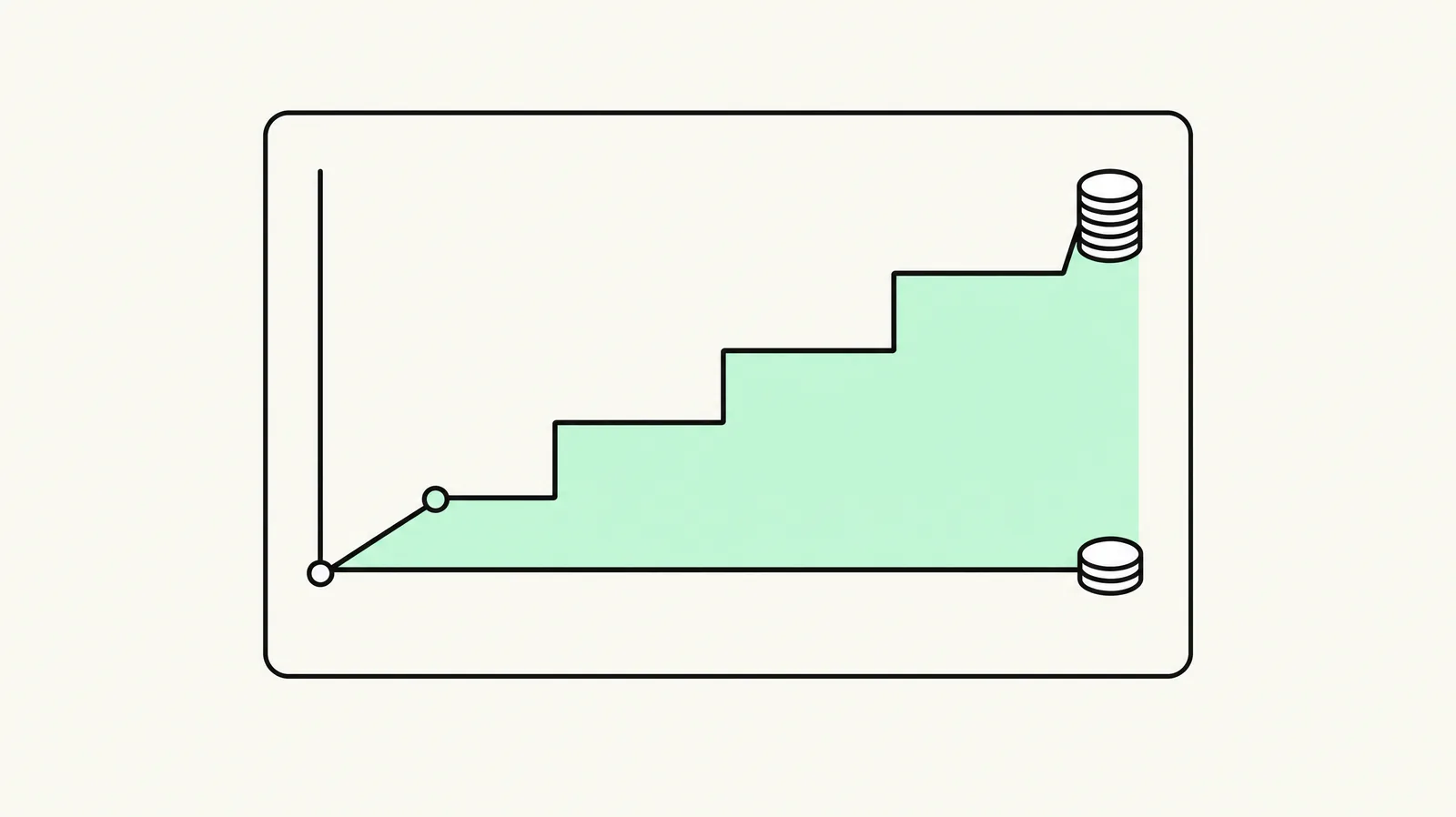
At $1K/month of tier revenue the two are identical in price — the comparison is genuinely neutral there, and should be decided on testing and track record. The crossover sits somewhere around $3–5K/month: past that, Kaching's cap model costs progressively more while Oxify's bill never moves. At $10K/month, the flat plan saves $540/year — real money, but the honest framing is that this is a few-hundred-dollars-a-year decision, not a margin-pivot. Choose on fit first, pricing second.
For how to judge tier profitability behind either app, the math is the same on both: contribution per visitor, not AOV.
Where Kaching is genuinely stronger
- Accumulated evidence. 5.0★ across ~6,600 reviews is the largest field-tested base in the category. Every edge case — themes, markets, app-stack collisions — has more live data behind it.
- Native A/B testing. The only major app in this class shipping offer tests natively. If you operate on the testing doctrine — one variable, contribution per visitor — this is a capability, not a checkbox.
- Zero-cost evaluation on dev stores. Agencies and partners can build and preview fully free before any client decision.
- Category gravity. The incumbent gets the integrations, the theme-compatibility fixes and the review volume first. That gravity is real and compounding.
Where Oxify is genuinely stronger
- Flat, capped-free pricing. One plan, every feature, no revenue ceiling — the cost curve that never moves.
- BYOB included. Build-a-box in the same $14.99 plan, where most rivals gate box builders to higher tiers or separate apps.
- Longer evaluation. 14-day trial vs 7 — enough time to run a real two-cycle test on fast-cycle categories.
- Agency alignment. The suite we operate on client stores — meaning the edge cases we hit get fixed at the source, which is a benefit you inherit.
Decision table by store profile
| Your store | Better fit | Why |
|---|---|---|
| Hero-SKU brand, testing discipline, <$5K tier revenue | Kaching | Native A/B tests + biggest evidence base |
| Tier revenue >$5–10K/month and growing | Oxify | Flat price wins the moment the caps start climbing |
| Build-a-box / gifting formats in the mix | Oxify | BYOB in the same plan |
| Agency/partner evaluating for clients | Kaching | Free dev-store builds |
| Budget-stage brand, want the safest pick | Kaching | Field-proven at your exact price point |
| Want to pair the ladder with a third-party test stack either way | Either | Intelligems-class tooling makes A/B capability moot |
Both apps live in our monthly-verified field of best Shopify quantity breaks apps alongside Pumper, Bundler and the rest — the head-to-heads there get refreshed each month as prices move.
Last updated: November 16, 2026. Ratings, review counts and prices verified against both apps' live Shopify App Store listings in November 2026.
Want this set up on your store?
Book a free 20-minute strategy call. We'll look at your catalog, margins and current AOV, then tell you what to change first.
Book a free strategy callFrequently asked questions
What's the main difference between Oxify and Kaching?
Pricing model and testing. Kaching is revenue-capped ($14.99→$59.99) with native offer A/B testing and the category's largest review base; Oxify is a flat $14.99/mo with no revenue cap and a build-a-box included, but no native testing.
Is Oxify cheaper than Kaching?
At under ~$3K/month of app-attributed tier revenue they cost the same or Kaching is cheaper. Past that, Oxify's flat $14.99 wins progressively — at $10K/month it saves $540/year.
Does Oxify have A/B testing like Kaching?
Not natively — pair it with a third-party experiment platform for offer tests. Kaching ships native A/B testing, which is one of its genuine advantages.
Which app is better for build-a-box stores?
Oxify — its BYOB box builder is included in the flat plan. Kaching's focus is the tier-selector offer set; for box builders it typically points to dedicated builders.