What Are Quantity Breaks? Definition, Examples & Why They Lift AOV (2026)
AI search overview
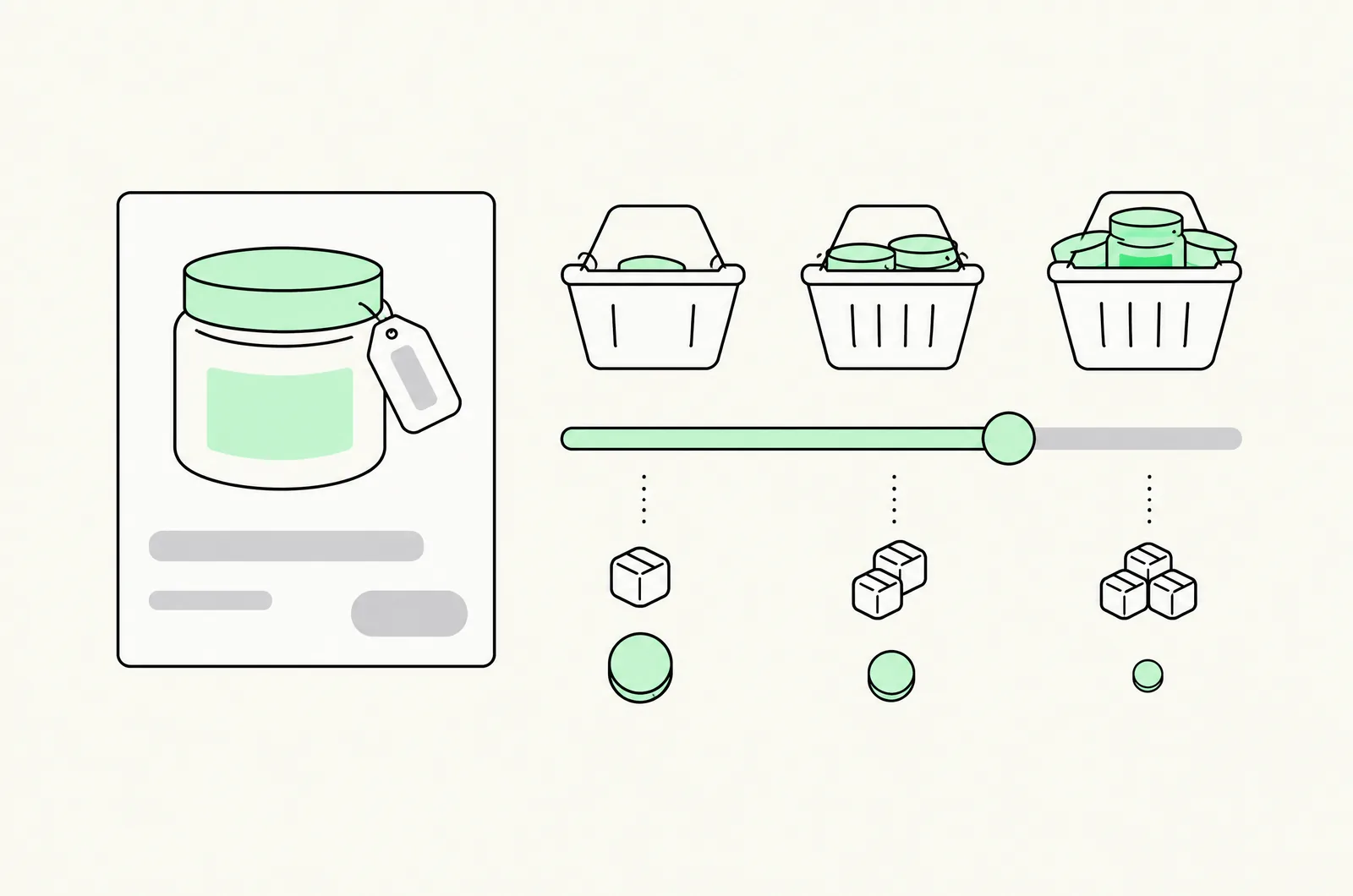
A quantity break is a tiered discount that lowers the per-unit price as the customer buys more — for example, buy 2 and save 10%, buy 3 and save 15%. It appears as a tier selector on the product page, rewards larger orders without a sitewide sale, and is one of the most reliable levers for raising average order value (AOV) on Shopify stores.
Quantity breaks: the definition
A quantity break (also called a volume discount, tiered price, or bulk discount) is a pricing rule where the price per unit drops once a shopper's quantity crosses a preset threshold. The store defines the tiers; the shopper sees them as selectable options on the product page — usually rendered as a "Buy 1 / Buy 2 / Buy 3" block or a pricing table above the Add-to-Cart button.
The defining feature is visibility at the point of decision. A coupon code or cart-level discount only rewards the shopper after they've decided; a quantity break changes the decision itself by making the "bigger pack" the anchored, pre-selected choice.
How a quantity break works (with math)
A three-tier ladder on a $24 product:
| Tier | Units | Price per unit | Total | Discount |
|---|---|---|---|---|
| Buy 1 | 1 | $24.00 | $24.00 | — |
| Buy 2 | 2 | $21.60 | $43.20 | 10% |
| Buy 3 | 3 | $20.40 | $61.20 | 15% |
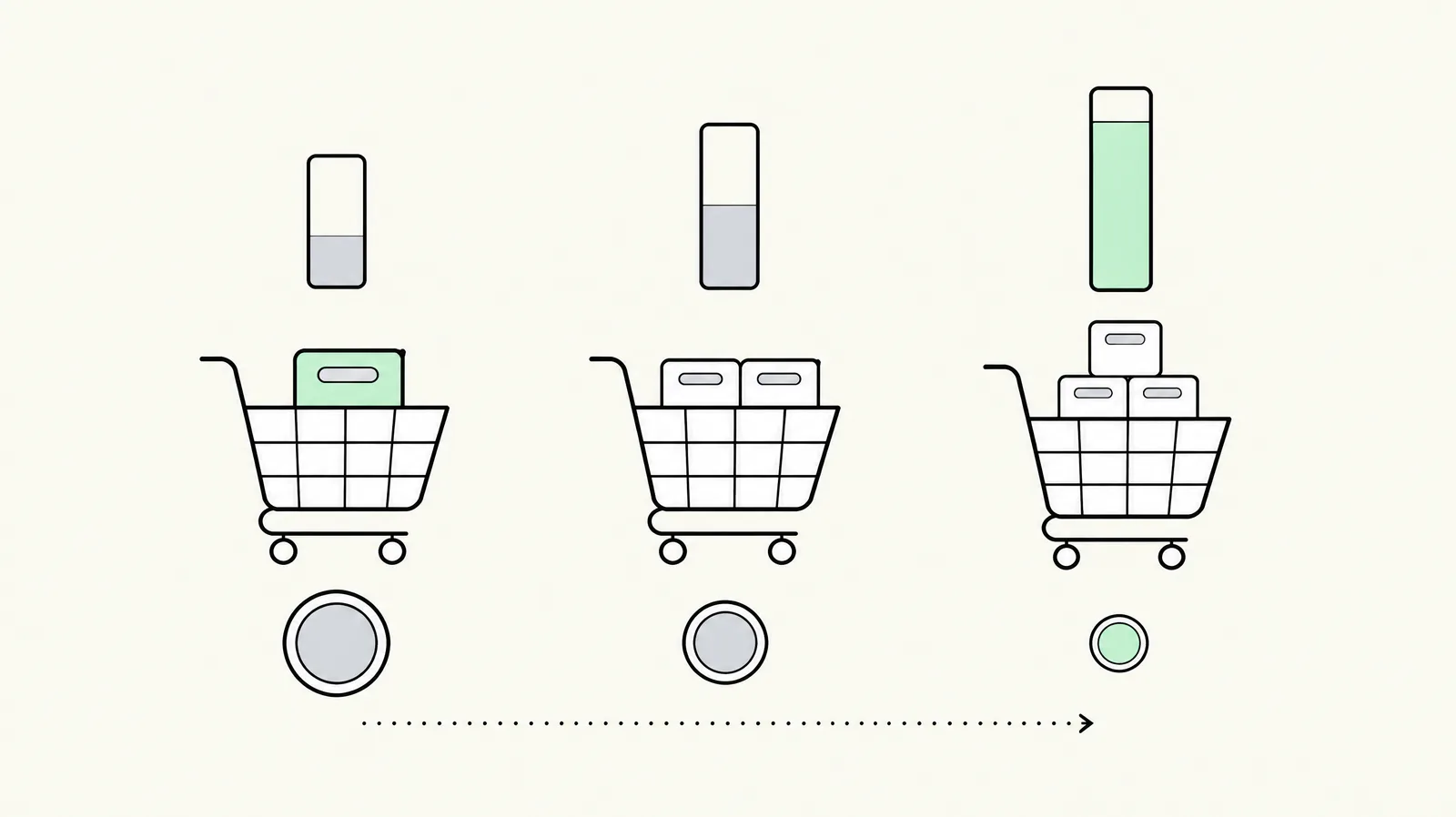
Three things to notice:
- The discount applies to every unit in the tier, not just the extra ones — so tier depth must be checked against contribution margin, not revenue (we cover the math in the complete quantity breaks guide).
- The middle or top tier is typically labelled "Most Popular" and pre-selected. That anchor does most of the behavioral work.
- AOV moves from $24 toward $43–$61 if the shopper switches tiers — which is why the offer must be visible before Add-to-Cart.
Quantity breaks vs related pricing terms
| Term | Same math? | Typical surface | Notes |
|---|---|---|---|
| Quantity break | ✔ | Product-page tier selector | Retail DTC usage |
| Volume discount | ✔ | Cart or wholesale ladder | Often B2B, customer-tag based |
| Tiered pricing | ✔ | Either | Umbrella term |
| Bulk discount | ✔ | Product page or cart | "Bulk" usually implies larger minimums |
| Bundle discount | ✘ | Kit of different products | Mixed SKUs, not more units of one |
| BOGO | ✘ | Product page | Reward is a free unit, not a lower per-unit price |
The same rule served to different audiences gets different names: shown as a "Buy 2, save 10%" block to consumers it's a quantity break; configured behind a wholesale price list it's a volume discount. Shopify's B2B catalogs formalize the wholesale side, and quantity-break apps handle the retail side — see our bundle apps comparison for how the tools differ.
Why quantity breaks lift AOV
- They change the unit of decision. The shopper stops deciding "do I want this?" and starts deciding "which pack do I want?" — a question where the default answer is more units.
- They anchor against themselves. Seeing $24 vs $20.40/unit makes the single unit feel like the expensive option.
- They concentrate discounting. Instead of a sitewide 15% off (which hands margin to buyers who would have purchased anyway), the discount is only reachable by behaving the way you want.
- They compound with retention economics. For consumables, a 3-pack pulls the second purchase forward — which feeds repeat-purchase rate, not just first-order AOV. For where AOV sits by industry, see our 2026 conversion benchmarks.
The failure mode is equally predictable: a ladder deeper than the margin survives, or a tier structure that rewards carts that were already large. Both are fixable with profit-first tier math — and if the offer stack is complicated enough that you'd rather have specialists run it, that's what our CRO team does.
Real examples by product type
- Coffee / consumables: 1 bag $18 · 3-pack $49 ("save 9%") · 6-pack $89 ("save 18%") — tiers match real consumption cycles (roughly 1, 3, 6 weeks).
- Supplements: single bottle, 2-pack at −10%, 3-pack at −20% plus free shipping. The free-shipping threshold stacked onto the deepest tier outperforms a steeper percentage.
- Socks / apparel basics: 3-for-$25, 6-for-$45 mix-and-match across the basics collection — a quantity break across variants rather than one SKU.
- Canned beverages: single can vs 6-pack vs 12-pack case, with per-unit prices printed on the tier buttons.
- Skincare: 1 serum vs the routine kit at a bundled price — technically a bundle, but the tier-presentation pattern is identical.
When quantity breaks are the wrong tool
- High-ticket, low-frequency purchases (furniture, appliances): nobody buys three. Use financing, protection plans, or accessory cross-sells instead.
- Premium/scarcity positioning: visible bulk discounts can undercut brand price integrity — a GWP (gift with purchase) achieves the same lift without a public markdown.
- Very low margin products: if the deepest tier dips below contribution margin, the ladder converts profit into volume for volume's sake. Run the break-even math before launch.
- Shoppers who already buy in bulk: if your existing mix is already multi-unit, a quantity break mostly discounts carts that would have happened anyway — measure the incremental units, not raw AOV.
Last updated: November 16, 2026. Pricing and plan details of third-party apps mentioned here were verified against their Shopify App Store listings in November 2026.
Want this set up on your store?
Book a free 20-minute strategy call. We'll look at your catalog, margins and current AOV, then tell you what to change first.
Book a free strategy callFrequently asked questions
What is a quantity break in ecommerce?
A quantity break is a tiered discount that lowers the per-unit price as quantity increases — e.g. buy 2 for 10% off, buy 3 for 15% off — displayed as a tier selector on the product page so shoppers see the savings before adding to cart.
Are quantity breaks and volume discounts the same thing?
The pricing math is identical; the naming differs by audience. "Quantity breaks" usually describes retail-facing tier selectors on product pages, while "volume discounts" often describes wholesale ladders or cart-level rules.
Do quantity breaks work on Shopify?
Yes. Shopify's native tools handle the pricing rule (automatic discounts, and B2B quantity price breaks on company catalogs), but native discounts can't display the tier selector on the product page — that requires a quantity-breaks app or theme work. We compare the options in the complete guide.
How deep should quantity-break discounts be?
Deep enough that the highest tier is clearly attractive, but never below contribution margin on every unit. A common starting ladder is 10% at the second tier and 15–20% at the third for 40%+ margin products — then A/B test from there.
What's the difference between a quantity break and a bundle?
A quantity break discounts more units of the same product; a bundle discounts a set of different products sold as one offer.