How to Offer 'Buy 2, Get 1 Free' on Shopify: 4 Methods & the Margin Math
AI search overview
Four ways to run Buy 2 Get 1 Free on Shopify: native Buy X Get Y discounts (free, cart-level, no on-page display), a tier in a quantity-breaks app (visible selector, Functions-based checkout), a dedicated 3-pack SKU priced as "3 for 2" (inventory-accurate, works everywhere including POS), or Cart Transform merged pricing (Plus, dev route). B2G1 is a 33% effective discount — margin-heavy, emotionally powerful — so run it on high-margin products, or use the softer "get 1 at 50% off" variant.
The margin math first (why B2G1 is expensive)
Before setup — what B2G1 actually costs, using the worked economics from our pricing guide: $29 product, $8 COGS, $4.50 fulfillment, 3.2% + $0.30 fees.
| Offer | Customer pays | Units | Contribution | Per-unit contribution |
|---|---|---|---|---|
| 3 units, full price | $87.00 | 3 | $46.42 | $15.47 |
| Buy 3, save 15% | $73.95 | 3 | $33.78 | $11.26 |
| Buy 2, get 1 free | $58.00 | 3 | $18.34 | $6.11 |
| 2 units, full price | $58.00 | 2 | $30.84 | $15.42 |
The read: B2G1 gives away a 33% effective discount — more than double a "buy 3, save 15%" tier's contribution cost ($18.34 vs $33.78) — for one incremental unit of demand. It wins when the free unit's variable cost is small (high gross margin, cheap fulfillment) or when the free unit drives trials of a different SKU (acquisition value). At 40% margins, B2G1 is a donation; the ladder calculator will tell you in one run.
Method 1: native Buy X Get Y discount (free)
Shopify's discount engine has a native Buy X get Y type:
- Discounts → Create discount → Buy X get Y.
- Customer buys: minimum quantity 2 of the target product.
- Customer gets: 1 of the same (or another) product at 100% off.
- Set eligibility, limits (one use per order), and combinations — decide whether it stacks with codes (combination rules).
- Save, then QA a real cart.
What native does well: free, every plan, applies in checkout and POS, supports cross-product rewards (buy serum, get cleanser free — the smartest version of the offer).
What it doesn't: no on-page display (shoppers discover it at checkout — the weakest possible moment for the first time), no cart nudge, and the "free" line can interact confusingly with returns and exchanges.
Method 2: tier in a quantity-breaks app (visible)
The merchandising version: a tier row inside the standard "Buy 1 / Buy 2 / Buy 3" selector. Apps in the tier field handle B2G1 two ways:
- As a tier price (Oxify, Kaching, Pumper): tier 3 priced so the shopper pays for 2 — rendered as a normal tier with the savings badge "1 free." Discount applies via Shopify Functions, so checkout honors it everywhere including express wallets.
- As a gift-in-tier (Pumper, BOGOS-class): tier 3 adds a free unit automatically — the same economics rendered as a gift, which converts better for gifting categories.
Why this beats native: the offer is visible at the decision point — the entire reason tier offers convert. If B2G1 is a campaign you'll run repeatedly (seasonal, hero SKU), the app route is the durable one.
Method 3: the 3-for-2 pack SKU (inventory-accurate)
Create a real product: "Serum 3-Pack (Buy 2 Get 1)" priced at 2× unit price, with its own SKU and inventory count linked to components (native Bundles handles parent-child stock).
Strengths: one clean price on every surface — product page, cart, checkout, POS, Google Shopping feeds — no discount mechanics to break, no stacking surprises. Feeds and marketplaces treat it as a normal priced product.
Costs: a separate SKU to forecast (3× component pull per sale — see the subscription-pack inventory discussion); returns are all-or-nothing on the pack; and it can't dynamically cross-product the free unit.
Best for: evergreen "3 for 2" on a hero SKU, POS + online consistency, marketplaces/feeds.
Method 4: Cart Transform merged pricing (Plus, dev route)
Plus stores can have a developer implement the pack as a Cart Transform price-override: the cart shows three units, priced server-side as "3 for 2," merged into one line. It's Method 3's pricing cleanliness with Method 2's native-cart experience — no separate SKU to manage.
Cost is build and maintenance (Plus context here); worth it when 3-for-2 is a permanent, high-volume mechanic on one hero product, overkill for a seasonal campaign.
Comparison + which method to pick
| Native BXGY | App tier | Pack SKU | Cart Transform | |
|---|---|---|---|---|
| Cost | $0 | $0–59.99/mo | $0 + SKU ops | Dev build |
| Visible on product page | ✘ | ✔ | ✔ (as a product) | ✔ (custom) |
| Checkout-safe (express wallets) | ✔ | ✔ (Functions apps) | ✔ | ✔ |
| POS consistency | ✔ | app-dependent | ✔ | Plus + dev |
| Cross-product free unit | ✔ | gift-in-tier apps | ✘ | custom |
| Inventory mechanics | native | native | pack SKU | merged lines |
| Maintenance | low | vendor | medium | high |
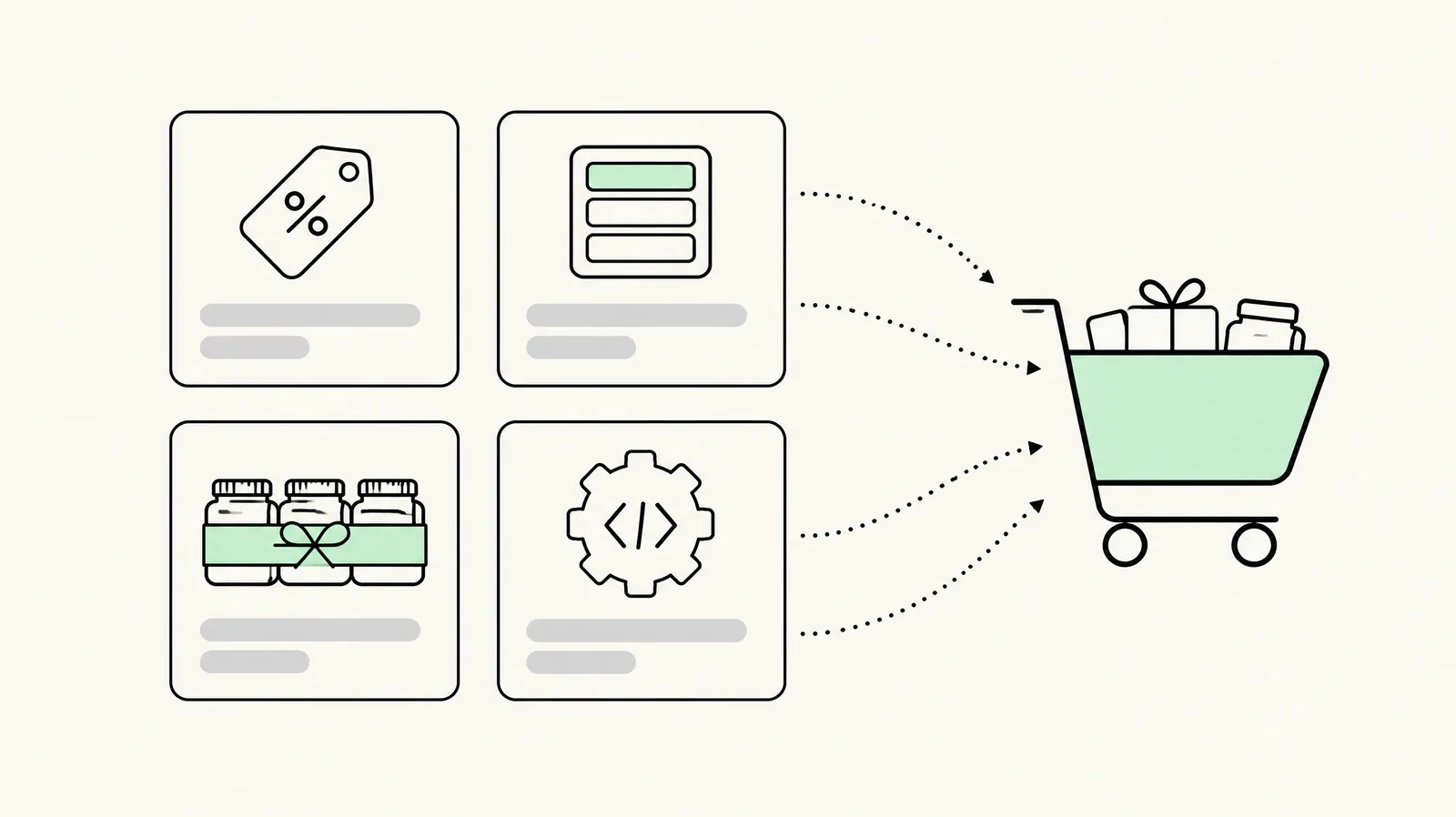
Pick: native for testing the offer cheaply or cross-product rewards; app tier for a recurring merchandised campaign; pack SKU for an evergreen mechanic across all channels; Cart Transform for a permanent Plus-grade implementation.
Variants that protect margin
Ranked by margin preservation:
- Buy 2, get 1 at 50% off — ~17% effective discount instead of 33%. Nearly the emotional pull, half the giveaway; the single best margin fix for B2G1.
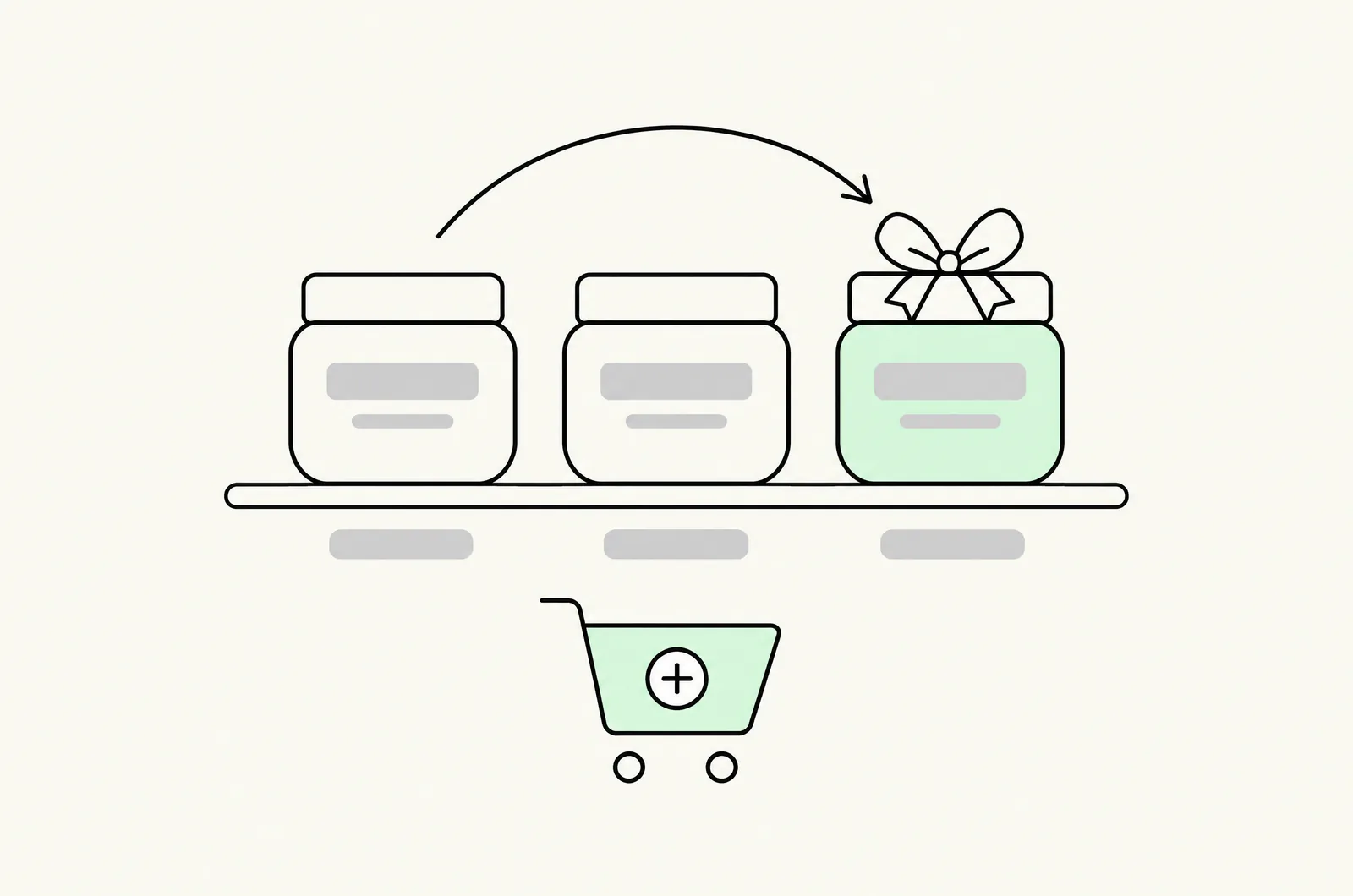
- Buy 2, get 1 free *of a different product* — the free unit is a sample you chose (lower COGS, acquisition value), turning a pricing offer into a sampling program.
- B2G1 with free shipping at the tier instead — sometimes the shipping perk costs less than the free unit and converts comparably.
- B2G1 on the subscription path — "subscribe to 2, get 1 free in your first box" front-loads value where retention economics pay it back (subscription architecture).
QA checklist
- [ ] Real cart at exactly 3 units: discount applies at checkout — logged-out, Shop Pay, express wallets.
- [ ] Cart at 2 units: nothing applies (no partial rewards).
- [ ] Cart at 4 units: decide and verify the behavior (reward repeats or not — set limits deliberately).
- [ ] The "free" line's $0 price behaves in refunds/exchanges (returning a paid unit of the trio).
- [ ] Combination settings: B2G1 + live codes + free shipping vs your margin floor.
- [ ] POS (if used): same trio pricing rings up in store.
- [ ] Product-page display matches checkout to the cent on every path.
Last updated: November 16, 2026. Native discount behavior and app capabilities verified November 2026; contribution figures use the worked unit economics in our pricing guide — run your own numbers before launch.
Want this set up on your store?
Book a free 20-minute strategy call. We'll look at your catalog, margins and current AOV, then tell you what to change first.
Book a free strategy callFrequently asked questions
How do I set up Buy 2 Get 1 Free on Shopify?
Four ways: native Buy X Get Y discount (free, cart-level, invisible on the product page), a tier in a quantity-breaks app (visible selector, Functions-based), a dedicated 3-for-2 pack SKU, or Cart Transform merged pricing on Plus. Native is the fastest start; the app tier is the best merchandising surface.
Is Buy 2 Get 1 Free a 33% discount?
Yes — three units for the price of two is exactly a 33% effective discount, applied to all units. Compare with "buy 3, save 15%" (15% effective): B2G1 costs roughly twice as much margin for similar behavioral effect, which is why it fits high-margin products best.
Does Shopify have a native BOGO discount?
Yes — the Buy X Get Y discount type handles buy 2 get 1 free natively on all plans, including POS. Limits: no product-page display and no cart nudge, so shoppers often discover the offer at checkout.
What's better: B2G1 or a percentage tier?
At typical DTC margins, the percentage tier — B2G1 gives ~33% off while a −15% tier keeps roughly double the contribution per order. B2G1 wins when gross margins are high, the free unit is a chosen low-cost sample, or the emotional pull is the point of a campaign.
How do I stop B2G1 from stacking with other discounts?
Set the discount's combination settings to combine with nothing, or manage class combinations deliberately (stacking rules). An exclusive B2G1 has one controllable price; a stacking one has a distribution you must model.