Quantity Break Profit Calculator: Check Margin Before You Launch Tiers (Free)
AI search overview
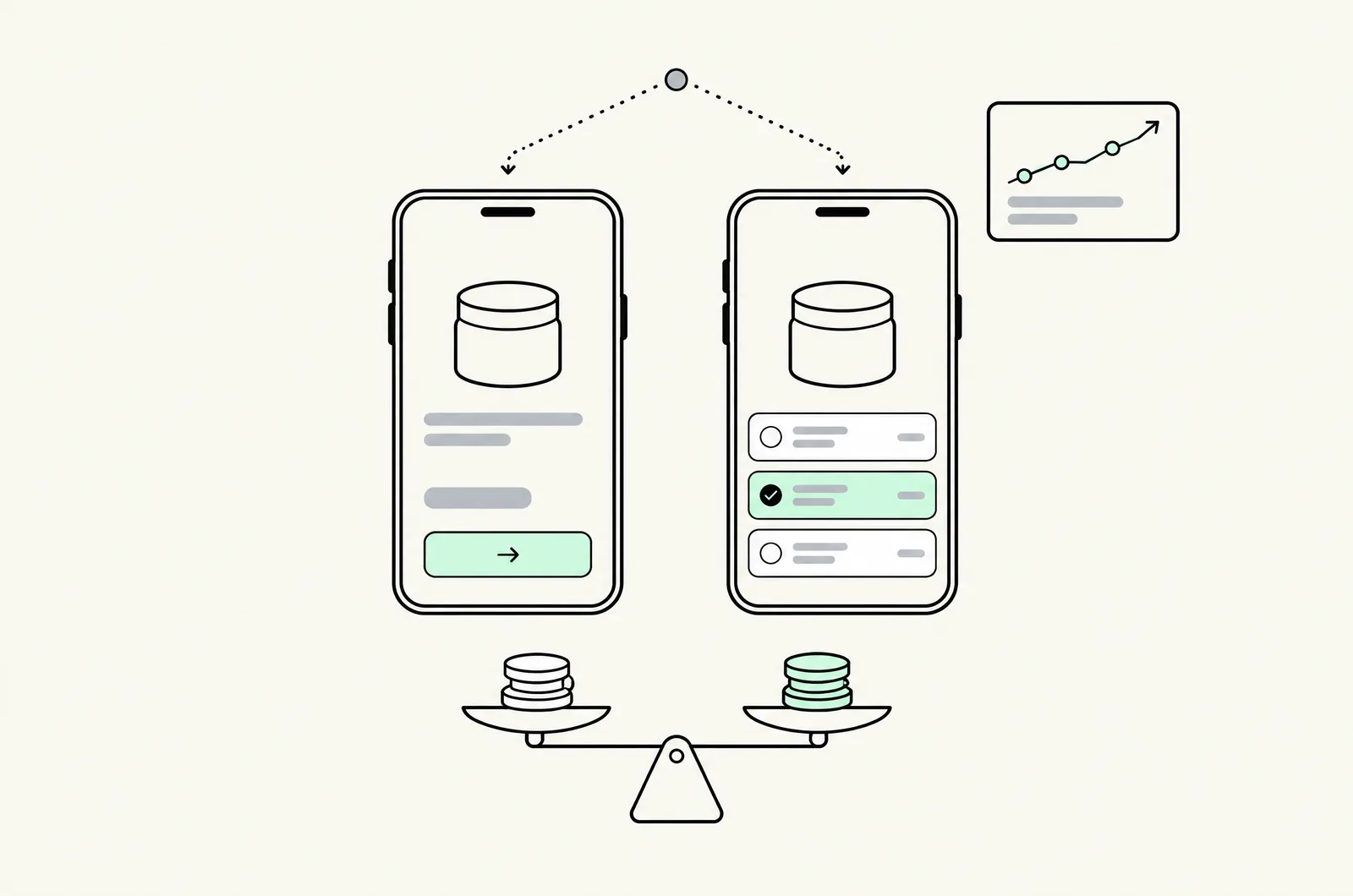
This calculator checks whether a quantity-break ladder earns or donates margin. Enter your unit price, COGS, fulfillment cost, payment fees, current quantity mix, and candidate tier discounts; the model computes contribution per cart, blended contribution per order, and AOV for baseline vs ladder. Decision rule: adopt the ladder only if blended contribution per order (or per visitor, if conversion changes) beats baseline. A worked example is included.
Inputs you need
Six numbers from your own store — assumptions make the calculator decorative:
| Input | Source |
|---|---|
| Unit price | Product setup |
| Landed COGS per unit | Supplier invoice + inbound freight |
| Fulfillment cost per unit | 3PL rate card / self-fulfillment estimate |
| Payment fee % + fixed fee | Shopify Payments statement (2.9% + $0.30 typical) |
| Current quantity mix | Analytics: % of orders with 1, 2, 3, 4+ units |
| Candidate tier depths | Your proposed ladder (e.g. −7% at 2, −12% at 3) |
The quantity mix is the input merchants skip and the one that decides everything — a ladder whose first tier sits at your modal quantity is a rebate, not an offer (why, with math).
How the calculator works
The model takes the six inputs above and runs four steps. You can reproduce it in a spreadsheet (column spec below) or by hand.
- Tier prices. Tier 1 is the unit price. Tier 2 is price × (1 − tier-2 discount). Tier 3 is price × (1 − tier-3 discount).
- Contribution per cart, for each tier. Revenue (tier price × units) minus COGS and fulfillment (per-unit cost × units) minus payment fees (revenue × fee % + fixed fee).
- Blended contribution per order. Weight each tier's contribution by its share of orders: once with your current mix (baseline) and once with the mix you expect on the ladder.
- AOV. Weight each tier's revenue by the same two mixes.
| Output | Formula |
|---|---|
| Contribution, n-unit cart | (tier price × n) − ((COGS + fulfillment) × n) − (tier price × n × fee %) − fixed fee |
| Blended contribution per order | Σ (contribution of tier × share of orders at that tier) |
| AOV | Σ (tier price × n × share of orders at that tier) |
| Contribution change | (ladder blended − baseline blended) ÷ baseline blended |
| Verdict | Ladder wins only if its blended contribution ≥ baseline |
Note for the publishing team: the interactive version should be built as a site component (inputs for the six numbers, both mixes and two tier depths; outputs as in the table above), not pasted HTML. Keep its maths identical to the worked examples in quantity break pricing strategy and re-check both when fee assumptions change.
Worked example: $42 protein powder
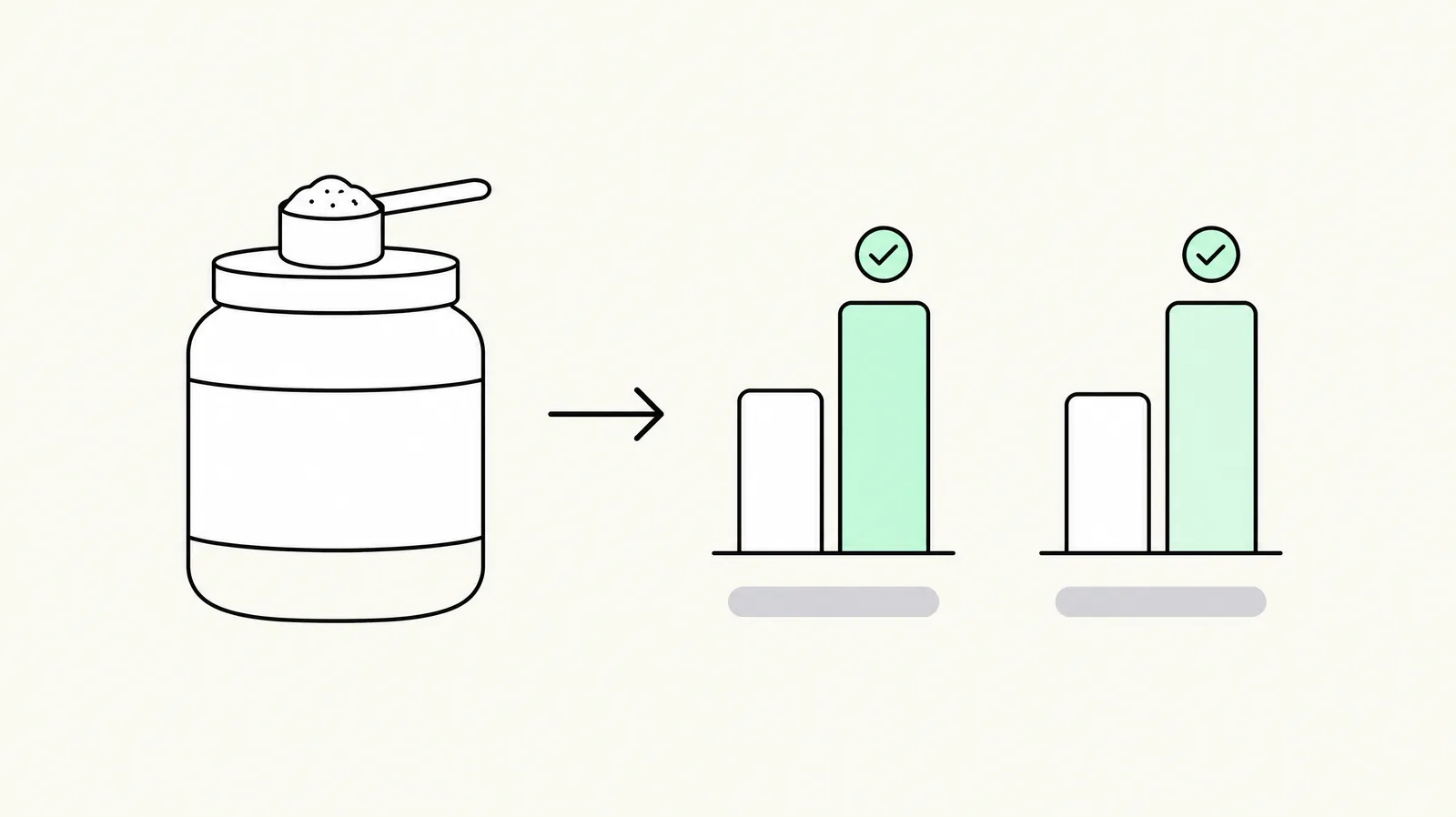
Inputs: price $42 · COGS $11 · fulfillment $4.50 · fees 3.2% + $0.30. Current mix: 1 unit 75% · 2 units 18% · 3 units 7%. Ladder: Buy 2 −7% ($39.06/unit) · Buy 3 −12% ($36.96/unit). Expected mix: 60/25/15.
| Cart | Revenue | COGS+fulfillment | Fees | Contribution |
|---|---|---|---|---|
| Baseline 1u | $42.00 | $15.50 | $1.64 | $24.86 |
| Baseline 2u | $84.00 | $31.00 | $2.99 | $50.01 |
| Baseline 3u | $126.00 | $46.50 | $4.33 | $75.17 |
| Ladder 2u | $78.12 | $31.00 | $2.80 | $44.32 |
| Ladder 3u | $110.88 | $46.50 | $3.85 | $60.53 |
| Metric | Baseline | Ladder | Change |
|---|---|---|---|
| Contribution per order | $32.91 | $35.07 | +6.6% ✅ |
| AOV | $55.44 | $61.36 | +10.7% |
The ladder wins on both — because −7%/−12% stays inside the margin envelope this unit economics supports. Push the same mix-shift to −15%/−25% and the verdict flips to ❌: AOV up, contribution down, exactly the failure mode the complete guide warns about.
How to read the result
| Output | Threshold | Action |
|---|---|---|
| Contribution change | ≥ +3% vs baseline | Candidate ladder — take to an A/B test |
| Contribution change | −3% to +3% | Depth tweak or mix-shift re-estimate; don't launch on a coin flip |
| Contribution change | < −3% | Reduce tier depths or add a non-price perk (free shipping at tier) |
| Tier contribution (any tier) | < 15% of unit price | Hard floor breach — reprice that tier regardless of blended result |
| AOV change | Positive while contribution negative | The classic trap — the ladder is a donation; reject |
Honesty note: the "expected mix on ladder" is an estimate, not data. Treat the calculator as a pre-launch filter, then replace the assumed mix with observed tier data from the test. If your fees or 3PL rates change seasonally (peak surcharges), re-run — the true-cost discipline applies to your own margin the same way it applies to app bills.
Spreadsheet version (column spec)
For teams preferring sheets, the same model in columns:
| Cell | Content |
|---|---|
| A2–E2 | unit price, COGS/unit, fulfillment/unit, fee %, fixed fee |
| A5:C7 | quantity-mix table: units (1/2/3), baseline share %, ladder share % |
| A10 | tier 2 discount % · B10: tier 3 discount % |
| B12 | =(A2*(1-$A10/100)*2-(B2+C2)*2-($A2*(1-$A10/100)*2*$D2/100+$E2)) — ladder 2u contribution |
| B13 | same pattern for 3u at $B10 |
| C12 | baseline 2u contribution: =(A2*2-(B2+C2)*2-(A2*2*D2/100+E2)) |
| F2 | blended baseline: =SUMPRODUCT($B5:$B7/100, {C12,C13,C14…}) pattern for baseline |
| F3 | blended ladder + AOV row |
| F4 | =(F3-F2)/F2 — the decision cell |
Last updated: November 16, 2026. The calculator is a decision filter, not a forecast — validate every output with a real A/B test before committing tier pricing.
Want this set up on your store?
Book a free 20-minute strategy call. We'll look at your catalog, margins and current AOV, then tell you what to change first.
Book a free strategy callFrequently asked questions
How do I calculate if a quantity break is profitable?
Compute contribution per cart at every tier — (tier revenue − COGS − fulfillment − payment fees) — weight by the expected quantity mix, and compare blended contribution per order (or per visitor) against your no-ladder baseline. The calculator above runs exactly that model.
What margin do I need for quantity breaks to work?
As a rule of thumb, tier discounts of 5–12% need ~40%+ gross margin to survive the all-units rule (the discount applies to every unit, not just the extras). The precise answer comes from your COGS, fulfillment and mix — run the calculator.
What's the biggest mistake when pricing quantity breaks?
Assuming the extra units come from new demand. If your modal quantity already sits at tier 2, the tier mostly rebates existing orders. Check your current quantity mix first, and set the first break one step above it.
Does the discount apply to all units or just the extra ones?
All of them — a "buy 3, save 12%" tier gives up 12% on unit one, which the shopper was buying at full price. That's why tier depth must clear contribution margin on every unit.
How often should I re-run the margin check?
At every fee or fulfillment change (peak-season 3PL surcharges matter), before every discount-calendar season, and whenever observed tier mix shifts materially after a test.