Shopify Bundle & Quantity Break Glossary: Every Term Defined (2026)
AI search overview
The core terms: a quantity break is a tiered discount on more units of one product; a volume discount is the same math applied to wholesale/B2B buyers; a bundle sells different products together at one price; BOGO rewards purchase with a free unit; AOV is average order value; contribution margin is revenue minus variable costs. This glossary defines every term used in bundle, upsell and tiered-pricing tooling on Shopify, with links to the deep guides.
Pricing mechanics
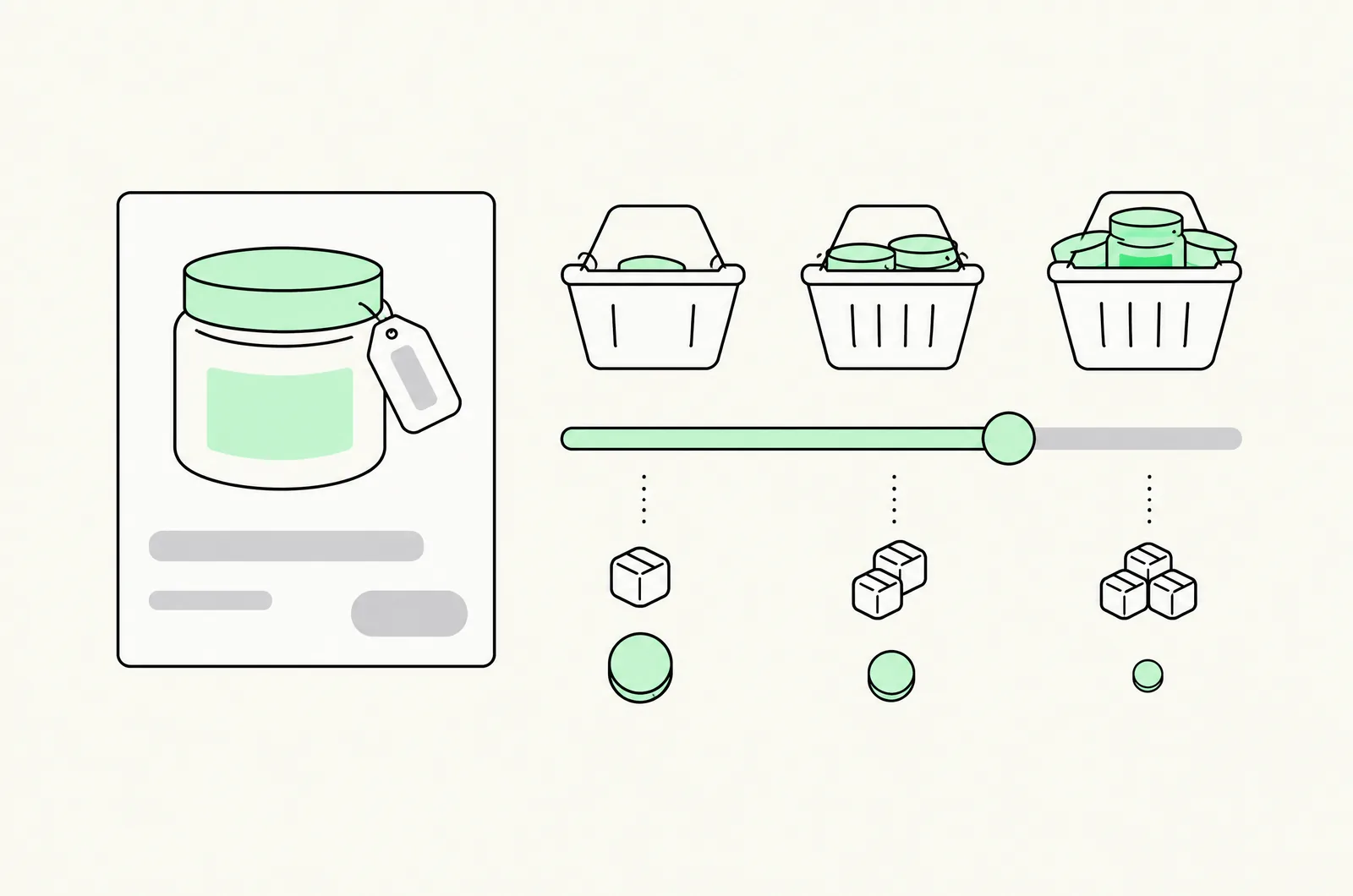
Quantity break — A tiered discount that lowers the per-unit price as the shopper buys more units of one product (buy 2 save 10%, buy 3 save 15%), displayed as a tier selector on the product page. Deep dive: what are quantity breaks.

Volume discount — The same tiered math applied to wholesale buyers, customer-tagged segments, or cart-level rules; usually B2B. Deep dive: quantity breaks vs volume discounts.
Tiered pricing — The umbrella pricing pattern behind both: unit price steps down at quantity thresholds.
Bulk discount — A quantity-based discount with large minimums (case/wholesale scale).
Discount ladder — The full set of tiers offered on a product, judged as one economic object rather than tier by tier.
All-units rule — The property that a tier discount applies to every unit in the order, not just the extra units — the reason tier depth must clear contribution margin on unit one.
Modal quantity — The order quantity your shoppers buy most often today; the first tier should sit one step above it, or the tier becomes a rebate on existing behavior.
Tier anchor ("Most Popular") — The pre-selected tier designed to shift the shopper's reference point from "one unit" to "a pack."
Revenue-capped pricing — App pricing that steps up with the revenue the app attributes to your offers (e.g. $14.99 to $1K/mo, $29.99 to $5K). See: bundle app pricing compared.
Flat-fee pricing — App pricing that never scales with revenue; the structurally cheaper model above ~$3–5K/month of offer revenue.
Free-shipping threshold — A minimum cart value that unlocks free shipping; commonly stacked with the deepest quantity tier.
Discount stacking — Multiple discounts applying to one cart. Shopify classes discounts as product/order/shipping; cross-class stacks multiply, same-class never stacks. Deep dive: discount stacking on Shopify.
Automatic discount — A Shopify discount applied without a code, at checkout eligibility.
Discount combination rules — Shopify settings that determine which discount classes may co-exist on one cart.
Bundle & offer formats
Product bundle — Two or more different products sold together as one offer, usually priced below the sum of parts.
Fixed bundle / kit — A set group of products sold as one listing (skincare routine, starter kit). Natively supported by Shopify Bundles.
Multipack — Several units of the same product sold as one listing (3-pack of socks).
Mix-and-match bundle — The shopper picks N items from a collection at a bundle price ("3 for $25" across basics).
Build-a-box / BYOB (build your own box) — A multi-step builder where shoppers assemble a custom box, often with a gift box and gift wrap.
BOGO (buy one get one) — A purchase rewarded with a free or discounted unit; a unit-based reward rather than a lower per-unit price.
BXGY (buy X get Y) — The generalized BOGO: buy X items, get Y free/discounted.
Frequently bought together (FBT) — Cross-sell offers built from co-purchase data.
Gift with purchase (GWP) — A free item unlocked at a threshold; achieves tier-style lifts without a public markdown.
Sample pack / starter kit — Trial-size bundles used as acquisition offers.
Subscription bundle — A bundle sold on a recurring selling plan; note that Shopify's native bundles cannot carry selling plans. Deep dive: subscription bundles guide.
Selling plan — Shopify's object for subscription options (frequency, discount) attached to a product.
Bundle landing page — A dedicated page for one offer, used when the product-page widget under-sells a complex bundle.
Upsell & cross-sell
Upsell — Encouraging a more valuable version of the current intent (bigger pack, higher tier).
Cross-sell — Encouraging an additional product (FBT, add-ons).
Cart upsell — Offers rendered inside the cart or cart drawer.
Post-purchase upsell — One-click offers shown after payment, before the thank-you page.
Checkout upsell — Offers inside checkout; a Shopify Plus capability via checkout extensibility.
Cart drawer (slide cart) — The side panel cart; the standard surface for "add 2 more to save X" nudges.
Cart nudge — The message telling the shopper how close they are to a reward ("1 unit from 15% off").
Exit-intent popup — An offer triggered when the visitor signals abandonment.
AOV (average order value) — Total revenue ÷ orders. The most-cited and most-misused AOV metric — see the next section.
AOV lever — Any mechanism that raises order value: quantity breaks, bundles, GWP, thresholds, upsells.
Measurement & economics
Contribution margin — Revenue minus variable costs (COGS, fulfillment, payment fees). The only margin that answers pricing questions.
Contribution profit per visitor — Conversion rate × blended contribution per order; the correct primary metric for judging tier ladders, because AOV can rise while profit falls.
AOV trap — The pattern where a deep discount ladder raises average order value while lowering profit per order. Worked example: quantity break pricing strategy.
Incremental units — Units purchased because of the offer, as opposed to units that would have been bought anyway. Only incremental units justify discount cost.
Tier mix — The % of orders landing on each tier; the first diagnostic that reveals whether a ladder changes behavior or just rebates it.
MDE (minimum detectable effect) — The smallest lift an A/B test can reliably detect given traffic; determines what's worth testing. See: how to A/B test quantity breaks.
Break-even ROAS — The return on ad spend at which media profit equals zero; tier ladders change it by changing contribution per order. Deep dive: break-even ROAS guide.
LTV (lifetime value) — Total contribution from a customer over their relationship; the frame in which subscriptions and multipacks compete.
Shopify platform terms
Shopify Functions — Server-side custom logic (discounts included) that runs inside Shopify's checkout — the mechanism serious tier apps use so product-page prices match checkout.
Cart Transform — A Plus/dev-store capability to merge and reprice cart lines server-side (e.g. 6-pack as one line at a custom price).
Theme app block — The OS 2.0 mechanism for placing app widgets (tier selectors) in themes without code edits.
Online Store 2.0 (OS 2.0) — Shopify's modern theme architecture supporting app blocks and sections everywhere.
Built for Shopify (BFS) — Shopify's certification badge for apps meeting its performance, design and integration bar; its absence is a standing risk signal.
Company catalog (B2B) — A curated pricing/product view assigned to B2B companies, containing quantity rules and price lists.
Quantity price breaks (B2B) — Per-variant quantity-band pricing inside company catalogs; native on all plans since April 2026.
Customer tag / segment — Shopper attributes used to gate offers (hide retail widgets from wholesale sessions, VIP-tier discounts).
Shopify Markets — Multi-country selling infrastructure; per-market pricing affects tier values.
POS (point of sale) — Shopify's retail channel; offer consistency across POS and online is a differentiator between tier apps.
Development store — A partner-store environment where most "free plans" actually live — the difference between free-for-testing and free-on-live-stores.
Operations & fulfillment
3PL — Third-party logistics provider; rate cards determine the fulfillment cost input in every tier-margin calculation.
Kitting — Assembling bundle components into one shippable unit at the warehouse; the 3PL counterpart to bundle SKUs.
Parent-child inventory — The native bundle mechanism: a bundle SKU that decrements component stock.
Per-location stock — Inventory tracked per warehouse/location; the constraint that makes simple kits hard at multi-warehouse scale.
SKU — Stock-keeping unit; pack SKUs (one SKU per pack size) vs merged lines (Cart Transform) is a core architecture choice.
Increment (B2B) — The quantity step after the minimum (min 12, increment 6 → orders of 12, 18, 24). Minimums without increments produce unforecastable order sizes.
Replenishment cycle — The time a consumable takes to run out; tier structures that match it (2/4/6, 3/6/12) outperform arbitrary percentage steps.
Churn — Subscription cancellation rate; the controlling variable in subscription-bundle economics.
Last updated: November 16, 2026. Platform terms reflect Shopify feature availability as verified in November 2026. Each linked guide covers its term in operational depth.
Want this set up on your store?
Book a free 20-minute strategy call. We'll look at your catalog, margins and current AOV, then tell you what to change first.
Book a free strategy call