Higher-ed enrollment
Higher-ed enrollment marketing against the UC and CSU calendar
Deposits and census enrollment for private California colleges, with net price explained before students compare offers.

Trusted by 50+ D2C brands · Google, Meta & Shopify partners









They've already seen a UC price
San Francisco, CA
Colleges statewide
Net-price first
Before sticker shock
Deposits and census
Not inquiries
Most California students applying to a private college will also apply to UC and CSU, and those applications close on 30 November. By the time a family compares offers in March, they've seen a UC or CSU price and, if eligible, a Cal Grant award, with FAFSA and California Dream Act Application forms due on 2 March. A private college that hasn't explained its net price by then is compared on its sticker price, and loses.
Enrollment teams also juggle several funnels at once. First-year recruitment follows high-school calendars; community-college transfer students follow transfer agreements and application windows; graduate and adult learners apply year-round and compare programmes on outcomes and schedule. Each needs its own campaigns, nurture and measurement, and the marketing budget usually treats them as one.
We work with colleges and graduate programmes as part of education marketing in California, from our San Francisco office. The work runs from inquiry to deposit and census, with separate funnels for first-year, transfer and graduate students.
Three places enrollment leaks
Each one loses students you could have enrolled.

Students compare you to UC and CSU
California students often see a public option and state aid before they understand a private college's net price. Without a clear net-price calculator, aid messaging and scholarship information early in the funnel, private schools lose admitted students in March to cheaper options they could have competed with.
Transfer students are under-recruited
California's community colleges send many students on to four-year degrees, but private colleges often recruit transfers with the same messaging as high-school seniors. Transfer students need course-credit clarity, articulation information and flexible schedules, and they apply on different timelines.
Graduate and adult funnels lack attention
Graduate and adult programmes often bring strong tuition revenue but get leftover budget. These students apply year-round, compare outcomes and flexibility, and need fast responses. Treating them like first-year applicants loses them to online programmes from out of state.
Six pieces of work, inquiry to census

Net-price and aid messaging
Net-price calculators, scholarship pages and aid explainers that sit early in the funnel, so families see the real cost before March.
First-year search and social
Campaigns timed to the autumn application season and spring yield period, aimed at students and parents.
Transfer recruitment
Pages and campaigns for community-college transfer students with credit and articulation information, timed to transfer deadlines.
Graduate and adult funnels
Programme-level search, LinkedIn and nurture for working adults, with fast response and outcome data.
Yield campaigns
Admitted-student events, personalised content and deposit reminders between admission and deposit deadline.
Deposit and census reporting
Inquiries, applications, admits, deposits and census enrollment by source and funnel, from your CRM and SIS.
Five recruiting markets, five kinds of student
Where students come from, and what they weigh.

Los Angeles
The largest pool of California college applicants, with many first-generation and bilingual families. Aid clarity and Spanish-language parent content matter.
San Francisco Bay Area
Competitive applicants comparing private colleges with UC Berkeley and other top UCs, plus working professionals seeking graduate degrees.
Orange County & San Diego
Strong applicant pools, military-connected students and many transfer students from large community colleges.
Sacramento & the Central Valley
First-generation students and adult learners in public-sector and healthcare careers. Net price and flexible formats decide choices.
Inland Empire
A fast-growing student population with many community-college transfers and price-sensitive families.
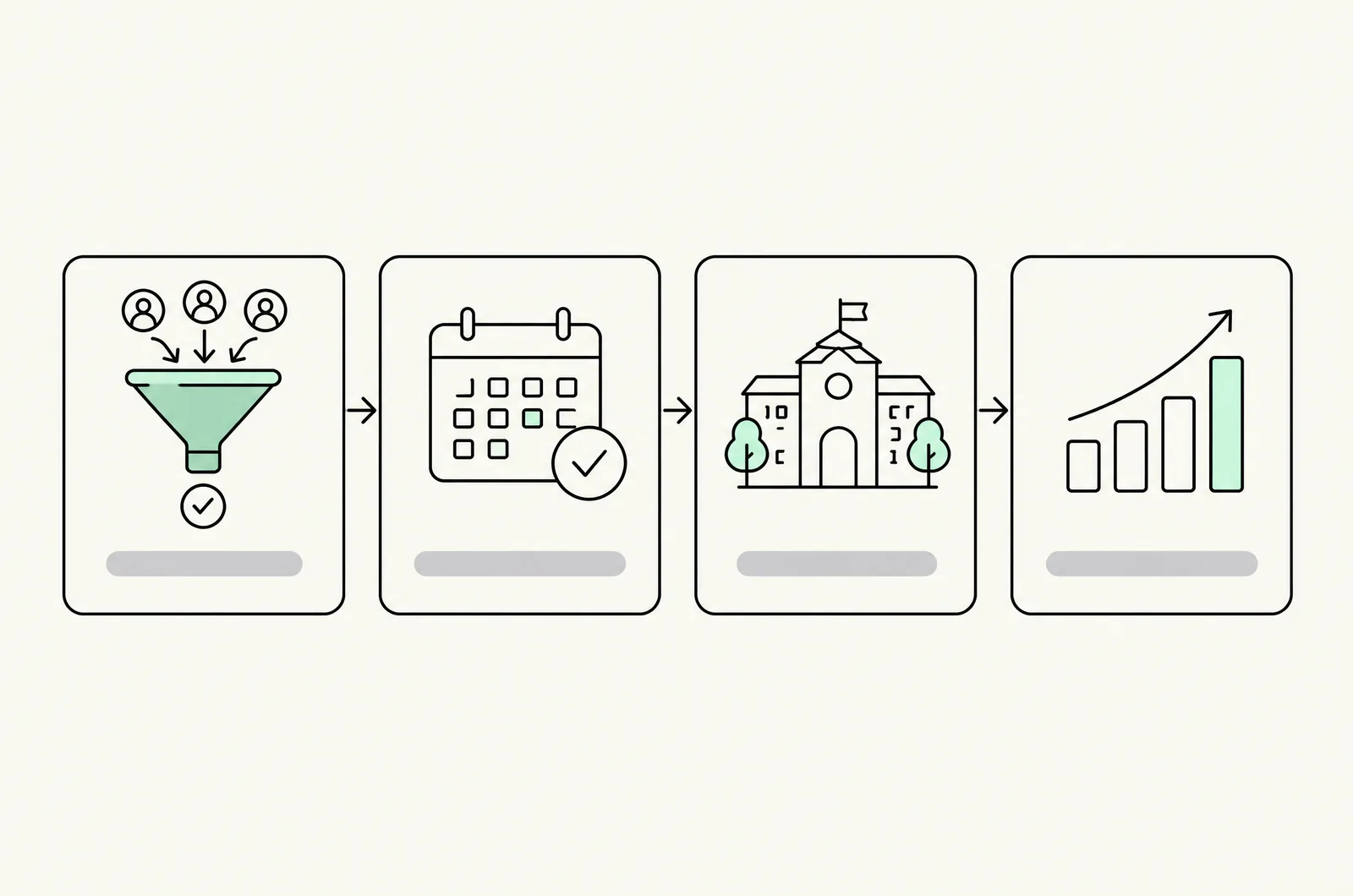
From funnel audit to census enrollment
- Step 01
Funnel audit
Inquiries to census by source, funnel and programme, plus where admitted students go instead.
- Step 02
Calendar and price
Campaign calendars around UC, CSU and aid deadlines, and net-price messaging moved early.
- Step 03
Run each funnel
Separate first-year, transfer and graduate campaigns, plus spring yield work.
- Step 04
Report deposits and census
Monthly applications, admits and deposits, and census enrollment by source.
A higher-ed specialist vs a national agency vs an in-house marketer
In-house costs are directional and depend on seniority and metro.
Plans around UC, CSU and Cal Grant dates
- National higher-ed agency
- National calendar
- In-house California hire
- Usually
- Conversion (San Francisco)
- Yes
Net-price messaging early in the funnel
- National higher-ed agency
- Sticker price ads
- In-house California hire
- Varies
- Conversion (San Francisco)
- Yes
Separate transfer and graduate funnels
- National higher-ed agency
- One funnel
- In-house California hire
- Limited capacity
- Conversion (San Francisco)
- Yes
Yield campaigns for admitted students
- National higher-ed agency
- Rarely
- In-house California hire
- Admissions-led
- Conversion (San Francisco)
- Yes
Reports deposits and census
- National higher-ed agency
- Inquiries
- In-house California hire
- SIS reports
- Conversion (San Francisco)
- Yes
Typical monthly cost
- National higher-ed agency
- $5,000–$25,000 fee
- In-house California hire
- $12,000+ per marketer (directional)
- Conversion (San Francisco)
- From $7,000 fee
A long decision, honestly compared
- Considered decision · Canada
4x
App user base
NDAX: one plan across channels
NDAX is a Canadian fintech app, not a college or a California client, and we have no published higher-ed result. What carries over is running several channels as one plan for a considered, regulated decision, which grew users 4x. College choice is a long, multi-channel decision too.
What enrollment marketing costs in California
USD, excluding media. Enrollment-based fees only where counsel confirms they're allowed.
One funnel
From $7,000/mo
First-year, transfer or graduate
Calendar-led campaigns, net-price messaging and nurture for one funnel, with deposit reporting. Media is separate.
- Calendar-led campaigns
- Net-price content
- Deposit report
- Most popular
Enrollment program
$14,000–$28,000/mo
All funnels
First-year, transfer and graduate funnels, yield campaigns and census reporting run as one plan.
- Transfer recruitment
- Graduate funnels
- Yield campaigns
Pay-on-results
Base + per enrollment
Qualifying institutions
A lower base plus a fee per enrolled student above an agreed baseline, counted at census, where permitted under federal aid rules.
- Baseline agreed up front
- Counted at census
- Compliance-reviewed terms
Higher-ed enrollment marketing questions

When should private California colleges recruit first-year students?
How do private colleges compete with UC and CSU on price?
How should colleges recruit transfer students?
Can colleges pay agencies per enrolled student?
Which California recruiting markets do you cover?
How much does higher-ed enrollment marketing cost?
How do you measure enrollment marketing?
How do you handle student data privacy?



Sources and statutes
Every figure and regulation cited on this page.
Facts and thresholds last checked 19 November 2026.
- University of California — First-year dates and deadlinesFiling period 1–30 November (opens 1 October); FAFSA, California Dream Act Application and GPA Verification due 2 March for Cal Grant.
- Cal State Fullerton — Admission deadlines (Cal State Apply)Cal State Apply opens 1 August; submissions from 1 October; priority deadline 30 November for fall entry.
- California Privacy Protection Agency — 2025 CCPA monetary threshold adjustmentsAnnual gross revenue threshold for a covered 'business': $26,625,000 (Civil Code §1798.140(d)(1)(A)).
Plan your next recruiting cycle
30 minutes with a senior strategist. Bring last year's funnel by source if you have it.
What happens next
- 1Pick a time for a 30-minute call.
- 2We review funnels, timing and net-price messaging.
- 3Get a calendar built around UC and CSU dates.
Prefer email? tarun@conversion.is